Showing posts with label kids. Show all posts

Monday, May 04, 2009

Pea-Eye, If you'll be my Mayberry, I'll be your Huckleberry

Patrick wasn’t really sure he wanted to go to Port Isabel to begin with; it was the seven-hour (from Austin) drive that gave him pause. It’s a long time for a 10-year-old to sit in a truck.

On the way home last night, he still thought it took far too long to drive to the southern tip of Texas but had decided it’s worth doing.

I agree.

Rockport, my hometown, has been my favorite place all my adult life. I called it “Mayberry-by-the-Sea.” Partly it’s the memories of a pretty good childhood there. Partly it’s the dozens of family members who still live there. Partly it’s the fishing.

Used to be, I’d make a trip at least once a month. Sometimes more often than that. Since last October, I’ve been home just three times. But in the same time I’ve made that seven-hour drive to Port Isabel five times.

Not as well-known as South Padre Island, its sister city across the causeway, Port Isabel maintains the charm and small-town friendliness I remember from 1980-era Rockport. With a population just under 6,000, it’s big enough to offer modern conveniences and small enough to easily navigate and meet the same people over and over again.

And the fishing can be phenomenal.

This weekend, Patrick out-fished both me and his Uncle John about five-to-one. He landed 18 fish of three different species and had a ball doing it. Our fishing guide Saturday, Capt. Carlos Garcia, has kids of his own the same age, and he was a patient and engaging teacher.

It was all about fun – feisty mangrove snapper, acrobatic ladyfish and hard-pulling jacks – and the promise of snook.

Port Isabel is ground zero for the Lower Laguna Madre’s burgeoning snook population. Anglers from around the world build multi-thousand dollar itineraries around the legendary game fish in South Florida, Costa Rica, Nicaragua and Belize.

And despite the fact the Texas record for common snook is a couple of pounds heavier than the world record for the same species, robalo are not much more than a footnote for most Texas anglers.

My brother, John, jokes that it is all just a vast conspiracy; he has yet to see his first big snook for himself. That didn’t change over the weekend, when 30mph winds turned the bay to chocolate milk and made fishing a bit tougher than usual. But we’ll make a believer of him yet; snook are just now moving out of the refuge of the Brownsville Ship Channel and out into the shallow waters of South Bay, Mexiquita Flats and other areas heavy on structure and bait.

A big linesider would have just been lagniappe this trip, anyhow. My son wants to be a battlefield archeologist when he grows up. Fortunately for him, my friend Rod Bates of Rio Bravo Gallery is a passionate and expert chronicler of the Port Isabel area’s rich history.

He told us the story of the 9-mile running battle between Union and Confederate soldiers that resulted in a victory for the South, 149 years ago and more than a month after Gen. Lee’s surrender at Appomattox.

Then he presented Patrick with Minie balls and uniform buttons from the battlefield – items Rod discovered on private land the battle crossed. Rod dug deeper into his collection and into history and found a couple of musket balls – one had obviously impacted someone or something – from the nearby Palo Alto Battlefield.

Palo Alto was the first major engagement of the Mexican-American War. You know, the one that gave the United States New Mexico and Arizona and California, as well as settled lingering border issues from the Texas Revolution a dozen years earlier.

From even farther back in time, he produced a silver coin from a 1554 shipwreck on Padre Island. Three Spanish treasure ships went aground in a violent storm then.

It was the last year of Charles I of Spain (he was Charles V of the Holy Roman Empire), and the coin bears his coat-of-arms and personal motto: “Plus Ultra.” – further beyond. Charles ruled much of Europe at the time, and the motto suggests a sort of transcendence and wide-armed embrace of, well, everything.

Which brings me back to Port Isabel. Looking for the best Gulf beaches in Texas? They’re right there – just a couple of miles over the causeway.

Want to tangle with a tarpon or battle a snook? For the next six or seven months, they’ll be everywhere around the town.

If history is your thing, or birds and butterflies, or antiquing or the best blackened fish tacos you’re likely to taste, Port Isabel has all of that.

It’s a town with a lot of character, and a lot of characters, too. Sort of like Andy Griffith’s fictional Mayberry. Only, by the sea.

Tuesday, February 19, 2008

Fossickers

Fossicking is a term found in Cornwall and Australia referring to prospecting. This can be for gold, precious stones, fossils, etc. by sifting through a prospective area. In Australian English, the term has an extended use meaning to "rummage". The term has been argued to come from Cornish. -- Wikipedia

Last week Tam and Patrick and I trouped down to the AGMS building on Burnet Lane for the monthly meeting of the Paleontological Society of Austin. I can barely say "paleontological," (seven syllables, count 'em), so I just call it "the paleo club."

Sometimes they refer to themselves as "dirt diggers."

We paid a whopping $20 for a family membership, and I think -- between the featured presentation and the expert IDs of some oddball specimens -- we got our money's worth the first meeting.

Good people. No surprise since, as my buddy Vince says, you can tell a lot about someone by how they feel about rocks. I was pleased to see Paul Hammerschmidt, a TPWD coastal fisheries biologist, there. Paul and I -- along with his son and some other folks -- went rock-hopping together at South Padre Island during the Texas Clipper sinking event. Nice guy with the kind of all-encompassing curiosity and enthusiasm that I identify with the very best scientists in any field.

Vince's office-neighbor Bill Kidd was there as well -- he and his wife are regulars -- as was Vince himself, with two of his daughters.

I heard the term "fossicking" for the first time twice in one night, from two different people. I like it; to my ears, it has overtones of "frolic" and ... well, it's just a fun word.

That was back in ... January, at our Twelfth Night party. Aimee, my cousin Geoff's geologist wife, gleefully sang out the word when I showed her some recent find. She had picked it up while fossicking in Australia.

Later in the evening, my friend Dub, also a geologist by trade, said: "Man, you guys have really been doing some fossicking ..."

Dub arrived after Aimee and Geoff left for the evening, and brought with him a housewarming gift of a beautifully cleaned and preserved exogyra ponderosa. It's the single best housewarming gift anyone has ever given us, and sits on the mantle now.

On the way home last Tuesday, Patrick broke a short silence with: "Daddy, that was fun!" It probably didn't harm his appraisal of the event that he left with a box full of give-away fossils (including some small ammonites and some very cool gastropods ... er, snails).

Sunday, November 18, 2007

The sea that was

It was kind of like the Antiques Road Show Sunday, only better; at the Texas Natural Science Center at UT, staff and volunteers manned tables labeled with signs like: "Vertebrate Paleontology," and "Sea Creatures," and "Rocks and Minerals."

Patrick and Tamara and I made the journey uptown with a heavy bag of rocky stuff -- a year's worth of collecting here and there -- to confirm independent (and sometimes informed) guesses and third-party IDs, and to get the skinny on some things that were complete mysteries to us.

Vince and Barbara Terracina, our friends and neighbors, were already there with their kids when we arrived.

Saturday, Vince and his next-door neighbor and good friend Richard, took the Terracina kids to a road cut in Hays County that Vince and I explored last weekend on the way back from the Nueces River. We met the Terracinas and Richard (and Maggie, the good dog) there.

We arrived early at the site high on a county road south of US Hwy 290, and Vince apologized when he got out of his car: "Sorry to ruin the peace and quiet."

Tamara and I agreed the "noise" of the kids was preferable: "Daddy, Daddy! This is a really good spot!" and "Daddy! Look at what I found!" and "Mr. Richard, can we go over there?!"

"I can't believe I haven't brought the kids out here before," said Vince.

And -- truly -- it is an amazing site. When we first arrived, Patrick was eager to skip lunch and get right to collecting.

"I'll give you one minute," I said. "See if you can find a fossil."

In 40 seconds he was back with five good specimens.

Most of the fossils in our bag -- including those from the incredibly rich site in Hays County -- were marine invertebrates; steinkerns (interior molds) of clams and snails.

One of the most common is a bivalve that is often called a "Texas heart" or "deer heart;" the molds may be of any one of several related animals. One of ours is Granocardium pseudopendens.

Among the most spectacular finds at the Hays County site were a handful of echinoderms; asymmetrical sea urchins in the genus Hemiaster.

The best specimens retain the bumpy surface where fuzz (not spines, in this case) attached to the critter, and clearly show the "star" recognizable today on contemporary sand dollars.

Among the other treasures we had identified were the little Cretaceous oysters called Ilymatogyra arietina -- we call them "Devil's toenails," which is a name most folks give to another genus altogether of extinct oysters .

We also identified a rare (for that period) brachiopod known as Kingena wacoensis.

Patrick was particularly proud of his example of a scallop still embedded in a limestone matrix. The shell, from the genus Pecten had been mineralized as chert and quartz, and sparkles under the light.

Patrick sees in the shell fossils proof positive that central Texas was once under water. He's right, of course; during the Cretaceous period (from about 165 million years ago to about 45 million years ago), Texas and much of North America was covered by a shallow sea called the Western Interior Seaway.

In 2001, the Intergovernmental Panel on Climate Change's Third Assessment Report predicted that by 2100, global warming will lead to a sea level rise of 9 to 88 cm (that's ... uh, 3.5 inches to nearly a yard).

The geologic record kind of puts things into perspective, doesn't it? I mean, the Hays Co. site is about 1,000 feet above the current sea level. (And yes, I know about eustatic and isostatic changes ... but do we really want to get into all that here? No? I didn't think so.)

In a sense, much of the limestone around (and beneath) us here is fossil something; calcerous planktons and algae and bivalves and brachiopods and gastropods and corals ....

Much of it is compressed and undifferentiated; in places where it is not, like in the Hays Co. road cut, we find fossils.

The vertebrate paleontologist at Sunday's event, Dr. Pamela Owen, identified one Corpus Christi Ship Channel bone as a piece of the plastron (bottom shell) of a land tortoise, and another as a rib bone from the extinct giant sloth.

The museum has a complete reconstructed skeleton of that impressive animal on the bottom floor. It's about the size of a Mini Cooper.

Many of our spoil island finds are associated with the Pleistocene epoch, the geologic time period from about 1.8 million years ago to just 11,500 years back.

In Texas, it was characterized by mega-mammals like giant beavers, mastodons, glyptodons (a huge armadillo species), sabre- and scimitar-toothed cats, short-faced bears, mammoths and the like. The coast was then more or less where it is now (the Texas barrier islands mostly formed since then, but the dune line was just a dozen or so miles farther inland, near where bay shores now are).

Some of my favorite fossils, from both the coast and the Hill Country, are the ichnofossils, or ophiomorpha -- trace fossils created by the burrows of mud shrimp or crabs or other critters.

Some of the fossils we brought in were so nondescript (weathered or otherwise altered) as to defy easy identification.
"Well, it's some sort of bivalve," one of the paleontologists said of one steinkern.

"I knew that when I got up this morning," Tamara remarked later.

It was great fun, though, to watch how respectfully and seriously the volunteers treated all of the treasures kids of all ages brought to them. One little girl brought her favorite rock to be identified by the fellow from the Bureau of Economic Geology.

The geologist questioned her about where she found it, and examined the perfectly smooth, triangular, white specimen carefully -- first with his naked eye, then under a microscope. Finally he carefully handed it back to her and said: "Well, I'd say it looks like you have a very fine piece of limestone there."

Perhaps the most fun, for me anyhow, was listening to a TPWD expert explain the history of something that was interesting from neither a geological nor biological standpoint: an early archaic spear point I found some time ago.

The point, he said, was made of central Texas chert and had been traded or washed downstream to South Texas, where I found it. It had been resharpened, several times, and some of the resharpening took place while it was still attached to the haft of the spear.

It was amazing to watch and listen as the archeologist brought to life events that took place 5,000-7,000 years ago, right here in Texas.

I think humans are by nature -- still -- hunters and gatherers; at least I am. I am also, by nature, a taxonomist -- I want to name and categorize things.

Finding fossils (or artifacts, for that matter) and then getting expert help in identifying them and the context in which they originally existed satisfies both of those deep-seated needs.

Plus, it's just a heck of a lot of fun.

Thursday, June 28, 2007

Odds and ends

Life is busy, busy, busy. Big changes in the offing on the homefront, seemingly ceaseless rain across the middle of the state (and accompanying busy-ness at work), lots of writing deadlines; I'd sure like to slow things down a bit.

Contrary to that deep-seated desire, I've been chatting back and forth with the editor of RoadTrip America about some brief web pieces. RTA pays comparatively well, I'll be roadtripping anyway, so ... why not?

One reason why not, or that gave me pause anyhow, is that web publishing demands some level of exclusivity; RTA likes all electronic rights in perpetuity. We've negotiated 12 months on text, 6 months on photos. So while I'd really like to write here about a fun road trip out to Menard, the 1750s Spanish acequia there and an adventure at the London crossing of the Llano River ... I can't. But look for it at RTA next month.

The good news that comes with all the rain across the state this spring is that the aquifers are full, the rivers and streams are full, and it should be a good paddling summer. It's a big change after a couple of drought years; in fact, right now there's too much water in some of the rivers I plan on including in the Falcon book.

My editors liked the sample material I sent, by the way, so I'm feeling more confident about being on the right track with that.

On the coastal paddling front, the long July 4 weekend will see me stroking north from Padre Island National Seashore to Rockport, my hometown. Tam's going to give coastal paddling a try, says if she doesn't like it she'll catch some rays on the beach and pick me up at the take-out.

The next weekend I'll paddle on up to Seadrift. Like much of the middle and upper coast, here redfish, trout and flounder will be on the fishing menu. But around Corpus Christi and Port Aransas, I'll also get a few shots at tarpon and snook and that's a pleasant prospect.

Patrick's been having a ball with his cousin Chris and their Grammi and Papa. Longview -- berry picking and the Texas State Railroad; Austin -- Children's Museum and gellato and some Daddy time; Ingleside -- beach today, fishing with Uncle John tomorrow and some more Daddy time this weekend ... it all reminds me of the kind of summers I had as a kid.

Did an in-studio interview about boating safety with Bryan Beck at KGSR-FM this morning, and was reminded that Austin really is a great music town. Stumbled across "My Baby Now," by Bruce Robison, earlier in the week. Good stuff, and ... well, I find it calming.

And while I'm making recommendations, check out Love Warps the Mind a Little by John Dufresne. I'm reading it again, a second run-through within 12 months, and it's lovely in about a dozen different ways.

Sunday, June 03, 2007

Renaissance

Confession: Secretly, I want to be a Rennie. Or maybe, more accurately, I want to have been a Rennie.

A "Rennie" is someone who participates in Renaissance festivals, also known colloquially as "faires" or "shows." There are scores around the country -- two big ones of longstanding in Texas -- and they are, in aggregate, an absolutely fascinating subculture.

I'm not certain I have the chronology right, but I think it goes something like this: in the 1970s, a California educator put on a weekend-long "market" festival with an emphasis on artisanship. It was sort of an outgrowth of back-to-basics hippie self-sufficiency, a reaction to the plasticization (in the sense that Ruben Blades uses the word "plastic" in his song of the same name) of late-20th-century American culture.

Over time, Ren faires grew to offer period costumes and performances, vendors offering an amazing array of arts and crafts and demonstrations of everything from soap-making to blacksmithing to glass-blowing.

At a Renaissance festival, visitors are likely to see everything from jousting demonstrations to pub wenches to mud beggars to virtuoso performances on the hammer(ed) dulcimer. It's modern-day vaudeville, with knife-throwing, puppetry, juggling and comedy routines that sometimes reach a level of sophistication and polish seen nowhere else. The Flaming Idiots got their start at Ren faires.

Historical accuracy apparently is not a strict requirement. There's a good deal of schlock, and more than a few anachronisms, mixed in with the art and period pieces.

Visitors will also see lots and lots of costumes; some are period (14th-17th c.) costumes, faithfully reproduced and worn. Others are complete flights of fancy, or -- more accurately -- fantasy. Like the gentleman in bright blue leather armor and Justin roper boots I saw opening weekend at Scarborough.

The phenomenon has given birth to its own jargon, as true subcultures must; my 8-year-old son is, for now, a "playtron." A patron who comes in costume. It's not a stretch for a boy who is, predictably, enamored of knights and castles, swords and wizardry. The Lord of the Rings and the Harry Potter movies weren't blockbusters for nothing.

I was vaguely aware of the Texas Renaissance Festival and Scarborough Faire. More than vaguely, truthfully; I had a secret yearning to go and see and participate.

Two developments recently have made this possible.

The first, of course, is Patrick's interest. Where else is he going to be able to spend a day in his knight costume and test his jousting skills on the quintane? Where else will he be addressed, dozens of times throughout the day, as "m'lord?"

At Scarborough last weekend he was recruited, on the street, by an enterprising Borgia who offered him 50 gold florins to kill Oliver Cromwell. It was a genius strategy, I thought: after all, who would suspect an innocently smiling, tow-headed 4-foot assassin? Even if he does go by "Sir Patrick the Sinister." (At the risk of giving away his advantage in swordplay, it's because he's left-handed.)

Patrick experienced a Renaissance festival -- TRF near Houston -- before I did. In the end, though, his interest could simply be another of those things parents tolerate to humor their kids.

My other entree into the Ren world is in some ways more significant.

Renaissance is a vital part of Tamara's enchanting story. For more than a decade, she "did the circuit," a series of shows that kept her on the road and engaged in an earthy, hippie art and performance culture six months out of the year.

Today she has a highly responsible and remunerative position with a successful Austin software company. She's come to treasure things like indoor plumbing, air conditioning and -- lately -- down comforters. She's happy to have health insurance and a 401(k).

In some respects Tamara is pretty typical of the other Rennies I've met: bright, well-read, highly creative ... most of these folks could make a go at just about anything they turned their hands to. The shows do for them what Austin does for musicians: allows them to make a living doing what they love best in a world that too often values "counters" over "makers."

It was a big leap for Tamara, to leave the Ren world and pursue a "straight" job. Her best friends -- people she has known and loved for two decades, in some cases -- are, many of them, still on the road. A few have opted for a more settled existence. The lucky ones, in my view, manage to keep one foot in each place.

Tam has done that by working hard to maintain those relationships, making herself useful in small ways on show weekends and being very, very careful not to violate the many unwritten rules of the tribe.

Some of those rules, I think, have to do with how much access is given to outsiders, how far they are allowed to penetrate that culture.

I am an outsider. I have a straight job, have only ever held straight jobs. I don't own a costume. I am not an artist, or even a particularly competent craftsman. My last dramatic effort was a run as Ensign Pulver in a UIL One-Act Play production of "Mister Roberts."

Bringing me along as she bridges the gap between her two worlds carries risks for her, not the least of which is loss of credibility and ostracization from her tribe. For me the risk is rejection, embarassment -- the kind a foreigner feels when mistaking an idiom or violating a taboo, being responsible for somehow separating her from a part of her life that is still very important to her.

As Tamara has revealed to me, bit by bit, more of her story and given me more insights into the Ren world, I've wondered at how honestly curious I am and how easily accepting I have been of the whole fantastic hippy-pagan-gypsy-crafting lifestyle.

But as I've traded story for story, and my memory was jogged by things she said, I've finally come to see it as No Big Surprise.

Some of my earliest best memories are of helping my grandma in her shop in Rockport. A retirement enterprise for my grandparents, it was something of a typical tourist trap -- full of sea shells and postcards and (this being before China's cheap-labor hegemony) imports from Mexico.

Alongside the rusty cutlasses and faux armor and serape-draped stuffed frogs, there was some genuine craft: lampshades created from thinly-sliced, translucent stone; paper weights and toilet seats and bric-a-brac preserving anything of interest -- shells, gems, fossils ... rattlesnake rattles? -- in heavy plastic resin.

Grandma made jewelry, and between her and my Grandpa there wasn't a rock or gem in sight that didn't receive at least a couple paragraphs of exposition. Grandpa was a water-witcher and a mushroom expert, could readily find and sort the tasty from the merely edible, the hallucinoginic from the lethal. A curious skill, now that I think of it, but one he shared with more than a few Rennies, if Ray St. Louis is to be believed.

Fantasy was so much a part of my life that I just assumed everyone had read Tolkien's trilogy three times by the time they were 15, and knew who Reepicheep and Aslan were.

My first great romance was with a beautiful, free-spirited woman who didn't particularly care for shaving under her arms but knew a whole lot about writing poetry, baking bread, milking cows and making cheese. I was blessed to have the opportunity to do all of that and more over long summer and holiday breaks at her family's farm in southwestern Wisconsin.

Even before that, and continuing on for years, I worked my way into my own tribe, a loose family of seafaring sorts -- long-distance cruisers, gunkholers, boat-builders. In my part of the world they, too, had a circuit: Texas Gulf Coast, the Mexican Caribbean, the Abacos, Bermuda, the Chesapeake ... it wasn't at all unusual to run into members of my hometown sailing club (and tellingly, it was the "sailing" club, not the "yacht" club) in Annapolis, or to meet a friend of a friend on Maryland's Eastern Shore, or see a familiar boat awaiting transit in Panama.

In Oxford, Md., a tidewater town founded during the historical Renaissance some four centuries ago, I was dropped-off to repair a boat and then deliver it back across the bay to Solomon's Island. I walked into my favorite watering hole there and asked the bartender where I could reprovision. He gave me directions, then threw me the keys to his truck.

Like Rennies, sailors help each other out, no questions asked. They are independent sorts, but loyal to the tribe; reluctant to be bound to the straight world of 9-5 drudgery, jealously protective of their freedom to pick up and go at a moment's notice.

Like other subcultures, the sailing -- especially cruising -- lifestyle comes with its own costumes, jargon and set of unwritten rules. Landlubbers, stinkpotters and wannabes stick out like sore thumbs.

But among the fraternity of cruising sailors, one can gain admittance by building skills and experience. Unknown drop-ins from over the horizon are welcomed if they can talk the talk and walk the (rolling) walk. Cred is awarded for miles under the keel and storms weathered.

Rennies are sometimes derided by the straight world as "those weird, hippie people;" sailors as "boat bums."

I seem to be drawn to both clans of dropouts from the mainstream.

Tamara asked me not long ago what I would like to see happen, with regard to bridging, with her, the gap between the straight world and the Ren world. I thought about it, and finally told her that -- best-case scenario, I'd like to be adopted by the tribe. At the very least, grudgingly accepted as a harmless interloper.

I'm not sure how to do that -- not sure, even, that it's anything I can somehow achieve on my own. It's important to me, though, because it speaks to some natural affinity; also, because it's important to Tam.

Patrick offered a clue to what might be one path. After we returned from a long day at Scarborough last weekend, we sat down to build catapults from a box of woodcrafting supplies Tamara had ordered weeks earlier.

We glued and rubber-banded various combinations of tongue depressors, clothespins and other parts together -- whose will hurl something farther, higher?

Later, when I was out of the room, my son turned to Tamara and asked thoughtfully: "So ... how many of these would we have to build to fill a booth?"

Monday, April 23, 2007

Patrick 1 -- Daddy 0?

Sunday afternoon, and I decide to take Patrick down to the lake to kill a little time. We belly up to the railing behind the LCRA's headquarters building at the bottom of Lake Austin, and before I have the fly rod unlimbered I see the first carp: it's a big one, playing hide-and-seek with the shadow of the dock at Hula Hut.

Patrick, meanwhile, is busy contemplating an earthworm someone left to dry on the concrete bulkhead. I cast between gusts of wind and one of several large carp -- a couple are in the 30-pound class -- mouths my fly before I strip it away. It will be the nearest-miss of the day.

Patrick decides he'll fish and makes a great first cast, right into the shadow of the dock, alongside a large, waterlogged tree limb. Several cranks into his retrieve and he announces something heavy is on the end of his line. I look down and see a flash of silver.

"Like, maybe a fish?" I ask.

"Oh yeah," he answers, "I have a fish!"

Patrick does a masterful job of keeping his rod tip high and his line tight as he negotiates the steps down to the lake-level landing. By himself, for the first time, he lips the bass and holds it up to be admired.

Lunch-goers at Hula Hut break into cheers and applause. Patrick gives an "aw-shucks" grin. I talk him through releasing the fish. I cast a few more times at the now utterly uninterested carp, Patrick observes the progression of crustiness in the discarded earthworm before deciding to commit it to the lake's food chain.

"You could use it as bait," I suggest. "It might catch a catfish."

"Why would I want to catch a catfish?" Patrick (now a many-bass-redfish-drum-trout-rainbow-and-speckled-ladyfish-mangrove snapper veteran) asks me.

My son has a point, I must concede, and rather than explain that some people fish for catfish, in fact pursue catfish with the fervor of a dedicated snook or striper angler, I silently pack up our gear.

On the way back to the truck, four times Patrick is stopped and congratulated on his catch. The shy grin reappears, and about the time we hit the parking lot he claps me on my lower back, as high as he can reach, and says: "It's okay Daddy. You usually catch a lot of fish."

He's done this before, provided comfort as eau de skunk wafts off me.

He's turning into the kind of angler I'll want to fish with. Not because he's my kid, but the kind -- like my friends Kendal and Dean and Brandon and Bobby -- who rejoices in another fisherman's good fortune and manages to remain modest about his own.

Which really makes the "score" irrelevant; we all win.

Sunday, January 28, 2007

Polar bears

One day a baby polar bear approaches his mother with a confused expression on his face and says, "Mom? Am I a polar bear?"

I arrived at the campground to find my only child sprawled on the ground, surrounded by a gaggle of 7-year-olds, his sneakers smoldering.

As I carefully removed his charred socks and then applied a rag soaked in icewater to the blisters on his ankles, he sobbed out the story.

Apparently he and three of his friends had been playing by the lake shore when they saw a large depression filled with grey powder. It looked interesting -- or maybe something on the other side did -- so they waded right through it, Patrick in the lead.

Later he said he thought the stuff drifting off the top was dust stirred-up by the wind. I suppose smoke might look like wind-blown dust. Or ash.

Either way, it was the last time he was truly warm the entire weekend.

"Well of course son!"
The cub replied, "You're sure I'm not a panda bear or a black bear?"

"Pack 20 Polar Bear Campout." The title of the event alone should have warned me away.

By sundown the wind whipping off the lake was truly cutting. The "observatory," which for some reason I had imagined as a heated, domed building with a sliding roof -- maybe with an open bar and a fireplace -- turned out to be a bunch of telescopes set up in a field at the top of a hill.

Brrr.

Later, after the campfire had been lit, various adults repeatedly warned the 70-some-odd elementary kids not to stray inside the logs laid around the fire. You could see that it was probably warmer in there, but you couldn't get quite close enough to tell for sure.

"No, of course not. Now run outside and play."
But the baby polar bear is still confused so he approaches his father.
The cub asks, "Dad, am I a polar bear?"


By 9 p.m., the wine was gone and there was nothing left to do but go to bed. Suddenly the "0-degree" sleeping bags Cabela's sent me looked inviting.

I tried for a few minutes to read by flashlight, but to do that I also had to leave my arms outside the bag. No good.

"Why of course son!" the papa polar bear gruffly replies.
The cub continues, "I don't have any grizzly bear or Koala bear in my bloodlines?"


10:30: I've inadvertently unzipped my bag in my restless sleep, and the cold is flooding in across my left ass cheek. I zip the bag up again and roll over.

11:23: I awake to the wailing of some Cub Scout's little brother, somewhere on the other side of the camp. The banshee-like screams continue until 11:47.

12:13: Patrick has rolled into the tent pole and I awake with a layer of nylon across my face. Our breath has condensed and formed ice on the inside of the tent.

2:21: I awake again and realize that I have to pee. I ponder this until about 2:29, when I decide it's just not worth it.

3:40: I really have to pee. I struggle out of my sleeping bag, don my hiking boots and jacket, and unzip the tent. It's freezing, probably because the evening's cloud cover has blown away. A million stars spangle the night sky. I hear something clattering on the ground as I go about my business. I'm pretty sure it's my urine, turning to ice.

4:17: Patrick rolls over and says: "I always wake up at this time when we're camping." Patrick, I say, it's 4:17 in the morning. "Oh," he replies. The diffused starlight through the top of the tent, refracted by the ice that has again formed there, looked like the gray light of dawn.

5:10: I awake from a nightmare in which the surgeon who performed my back surgery in June is standing over me, frowning and wagging his finger. I roll over and try to ease the ache that's spreading from my lower back into my thighs.

"No son. I'm a polar bear, your mother is a polar bear, and by god you too are one hundred percent purebred polar bear!! Why in the world do you ask?"
"Because I'm freezing my BUTT off!"


6:30: I wake-up again, and hear the voices of kids running across the campground. Maybe, I think, someone has coffee on. I stumble out of the tent and head across the campground. Still rubbing sleep out of my eyes, I stop and stare at the dad who apparently is standing in the fire. Sparks swirl and dance around him. I push through the two ranks of sleepy campers who are toasting their hands over the flames and ask him if there's room for two.

7:05: Sitting in my truck with the heat on high, trying to gather the courage to get back out and pack up.

7:27: Packing sleeping bags and the tent one-handed, as I desparetly clutch a cup of hot coffee in the other. Nick, the Cub Scout pack's grand poobah, walks over and hands Patrick a patch.

The patch shows three polar bears walking across an ice flow with the words: "It froze in Texas."

What?! These guys knew it was gonna do this? They knew far enough in advance to have patches made?

That's it.

For the second time in my life I'm quitting Cub Scouts. After I take a hot shower. And a nap.

Photos courtesy Pack 20.

Tuesday, December 26, 2006

"... one of the most exiting times of my life!"

I began a long post about our great adventure in South Austin today ... full of trivia about caves and caving and karst invertebrates and ... well, after reading my 7-year-old's journal entry on the same topic, I think I'll let him tell the story.

Reprinted with Patrick's kind permission:


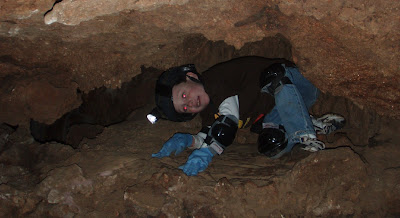
I will say this: after the three boys returned from their guided tour of the South Caverns (a couple of us old dads opted for a snooze in the slightly more spacious Travis County Room), they emerged from the passageway exclaiming: "That was the tightest place we've ever come out of!"

A moment of silence, then my brother and I together say: "Second tightest ...."

Here's what it (not the Birth Canal, but some other pieces of our adventure) looked like:


A big thanks to Aimee and Geoff, Patrick and Lauren, for helping make a great day-after-Christmas memory!