Showing posts with label inland. Show all posts

Sunday, December 09, 2007

Bless these men

Saturday I had the rare privilege of spending a couple of hours on the water with eight wounded warriors at Blanco State Park. The soldiers -- all undergoing medical treatment and various therapies at Brooke Army Medical Center in San Antonio -- were there as part of a "Heroes on the Water" outing.

Heroes on the Water is the first project undertaken by Kayak Anglers Society of America, founded by my friends Brad, Ken and Jim. This was their fourth trip.

Some of the guys told me about their "duty day" at BAMC: morning formation, then various appointments all day long, then back to a spare barracks room. One of the guys admitted that, a lot of times, it's easier to just stay locked-up in that room on a Saturday than attempting to get out and deal with the world.

Maj. Cody Roberson, a Medical Services Corps officer who founded ArmyBassAnglers.com, does a good job of protecting the troops from the raw curiosity of sponsors and spectators alike. Cody knows first-hand some of what they went through in Southwest Asia: he commanded a medical company there early in the war.

Two of the soldiers were amputees; some were injured in blasts, others were burn victims. Some had no immediately obvious injuries; following Cody's lead, I didn't ask.

There's no doubt in my mind, though, that every one of them is in some way broken by his experience; as Jon Dee Graham sings, "not beautifully broken, just broken ... that's all."

The Heroes on the Water program gives these troops an opportunity to get out, almost on their own, for a few hours. Sure, there are therapeutic aspects to kayak fishing -- fine motor skills, balance, strength; it's the sort of thing that is good for anyone to practice, but especially if you're, say, learning to use prosthetic thumbs. Or new legs.

But maybe the best thing about these excursions is the opportunity for the soldiers to simply relax -- away from case managers and appointments and the same ol' same ol' of their barracks rooms. To watch a wild turkey fly across the river, or feel the tug of a fish at the end of a line.

I've always had a soft spot in my heart for soldiers. As a kid, because I looked-up to them and admired them. As a young adult, because I was one. Now, because I remember.

I remember the difference it made to me when someone actually showed they appreciated my sacrifices.

I wonder at the kind of courage and strength it takes to even attempt to become truly whole again after the sorts of injuries -- and experiences -- these men have suffered.

Awe is not too strong a word for what I feel for these "warriors in transition," now that I have met a few of them.

Cabela's donated rods and reels for the outing, and the Blanco American Legion Post provided a late lunch. Blanco State Park staff opened their arms to the group and waived entry fees. Brad and Colleen Harvey of Heart of Texas Kayaks brought the boats. Such generosity is always humbling.

But a lot of it still comes out of KASA's -- Brad's, Cody's, Jim's and Ken's -- pockets. You can help sponsor the next Heroes on the Water trip (there's a waiting list 20 soldiers deep now) by donating online at http://www.kayakanglerssa.org/. Or, if you or someone you know would like to donate products or services -- fishing stuff, ice chests, transportation, PFDs, fishing garb or hats -- send Brad an email.

KASA is a non-profit corporation (501(c)(3) status is on the way), and donations are tax-deductible.

Tuesday, November 13, 2007

Nuts for the Nueces

Driving south from San Antonio on Interstate Highway 37, the first hint of the city of Corpus Christi is the gleaming profusion of refineries off in the distance: scaffolding and gas flares, storage tanks and distillation towers. At night, the lights look like a cityscape in their own right.

The refineries exist because of the Port of Corpus Christi -- the nation's sixth-busiest -- and the port exists because of the Nueces River.

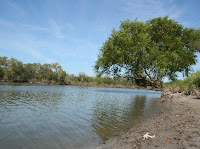
Shortly after the refineries come into view, the interstate crosses the river. Here it is a slow, silt-laden stream crawling between muddy banks choked with mesquite, willow and scrubby oaks. Just downstream, the river meanders into spartina marsh before emptying into the shallow, reef-strewn reaches of Nueces Bay.

That's the Nueces I grew up with.
It is a distinctly different river some 300 miles upstream at the western edge of the Edwards Plateau. Uvalde, about 50 miles from the river's headwaters and a good four-hour drive from Corpus, is the only other town on the entire river with a population above three digits, and it boasts only around 17,000 souls.

Last weekend, with four friends, I set out to explore that difference, and the river that has long been calling to me.

Marc McCord, writing for SouthwestPaddler.com, reports that: "The spring-fed, crystal clear water flows through the limestone bluffs of the Edwards Plateau, and is one of the most scenic river trips in Texas."

McCord also reports that some 45 miles of the upper Nueces, from north of Barksdale to near Uvalde, are navigable nearly year-round.

Not so, said Marilyn Stoner. Marilyn and her husband Tom own Clear Creek Outfitters in Camp Wood. From the paddling shop-and-antique store on the main drag, they rent kayaks, provide shuttles and counsel kayakers on current river flows and conditions. The advice and help with route planning is free to all comers.

"There is a lot of outdated information on the Internet," Marilyn told me when we stopped in Friday. "I don't recognize some of the things I read about the Nueces. This river changes all the time."

Marilyn warned us that the river is shallow in many places and we'd probably end up dragging the boats part of the way.

"There are rocks in some of those rapids that will eat boats," she said.
Of course, the same is true of most Hill Country streams. The classic pool-and-drop configuration of these spring-fed rivers, with the hard, limestone bedrock of the Edwards Plateau, mandate carrying a strap or line with which to pull boats and decent footwear for the portions the paddler will be forced to walk in ankle-deep water.

On the Nueces, even more than some other Hill Country streams, rises can come quickly. The river's watershed is huge -- it drains something like 17,000 square miles -- and a downpour out of sight and sound beyond a ridgeline can translate into a sudden wall of water under bright sun and blue skies somewhere else minutes or hours later.

To my surprise, I found the portions of the Nueces we paddled -- at what Marilyn and Tom said is average or just below-average flows -- to be more easily navigated than most Hill Country streams farther east.

On one six-mile reach I was forced out of my boat exactly once, and then only because I chose the wrong channel at the head of a riffle.

There are few legal camping spots along the river bed, and an even smaller number of comfortable ones. But with frequent county road crossings between Camp Wood and Uvalde, daytrips with overnights in one of several private campgrounds in the area is a good strategy.

We chose Big Oak campground just south of Camp Wood, where tent camping sites include water, electricity, fire rings and grills.

A trip like this isn't all about the paddling, after all, or fishing, for that matter.

It's also about leaving workaday concerns behind. It's about the joy of watching a belted kingfisher hover above a riffle, dive and emerge with a minnow in its beak. It's about the play of light and water and limestone, and a flock of wild turkeys coming down to drink.

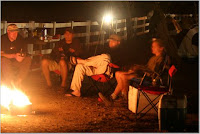
It's about good friends and good food and the lies guys tell around the campfire.

Vince (an old college buddy of like mind who I'm just now really getting to know) brought venison fajita meat -- and his Big Bend staple, Easy Cheese (I'm now a convert); Ken, my regular coastal paddling partner, provided a flask of apfelkorn. Danny -- my fishing partner of more than decade -- and Schu, another Houston friend, kept busy passing icey cans of Pearl Light around the fire.
After a full day of paddling -- and with well over 100 fish caught between us -- Saturday was an early night. After coffee and campfire eggs and sausage in the morning, we decided to break camp and enjoy the scenery on the way home rather than attempt the three-hour paddle we had planned for farther downstream.

For Vince and me, that meant heading 20-plus miles cross-country from Barksdale on an unpaved county road that wound through large ranches along the canyon carved by Bullhead Creek. That road connected to Ranch Road 336, which plunges south to Leakey.

From Leakey, it was left on my old friend FM 337 through Vanderpool and down to Medina.

Between Leakey and Vanderpool, Vince and I pulled off at a picnic area high atop a ridge to stretch our legs and grab a quick bite to eat. As we carved chunks of venison sausage onto saltines liberally spread with Easy Cheese, we heard a voice: "Good job! You're doing great! Just a little farther now ...."

We turned to see a young boy -- probably only 9 or 10 -- coast to a stop on his bicycle. Behind him came a man on a triple-seater, two younger children behind him.
I was amazed they had all pedaled up the hill we would soon coast down in my truck. Iwas even more amazed when the man told me they had come all the way from Medina, and their destination that evening was Camp Wood.

A Team Cyclone support trailer pulled in a few minutes later, so I guess they probably knew what they were doing. But still. Wow.

Closer to home, a quick stop at a top-secret fossil hunting site yielded the most numerous and perfect clam casts I have yet seen, as well as a handful of fossilized sea urchins. Family obligations kept us from lingering long, but we plan to take the kids back Saturday.

It's a fine coincidence that Sunday is one of two "Fossil ID Days" UT hosts each year. Look for a report on that expedition here after the weekend.

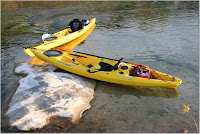
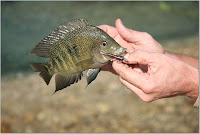
[The Nueces at LaBonte Park, alongside IH-37 just north of Corpus Christi. Note the dead crab in the foreground; still life with boats on the Nueces River near Big Oak River Camp; this view of Ken's right foot gives a pretty good idea of both the water depth and quality in the upper Nueces (photo courtesy KendalLarsonPhotography.com); Schu and Danny negotiate a snag in a tight bend on the upper Nueces below Camp Wood; A nice Rio Grande perch, the only cichlid native to Texas; Danny, Ken and Vince show-off a largemouth bass triple-header; Vince admires a nice Nueces River Guadalupe bass; Ken goes for broke with the Easy Cheese; sitting around the campfire; You never know what you might see on the roads through the Hill Country. Here, two camels kiss; Five tired but happy bikers at the top of the ridge between Vanderpool and Leakey ; even if you don't paddle, or fish, the trip to Camp Wood is worth it for the amazing scenery. We figure the more warning signs, the better the drive (photo courtesy Vince Terracina, TAG Marketing).]

Thursday, June 28, 2007

Odds and ends

Life is busy, busy, busy. Big changes in the offing on the homefront, seemingly ceaseless rain across the middle of the state (and accompanying busy-ness at work), lots of writing deadlines; I'd sure like to slow things down a bit.

Contrary to that deep-seated desire, I've been chatting back and forth with the editor of RoadTrip America about some brief web pieces. RTA pays comparatively well, I'll be roadtripping anyway, so ... why not?

One reason why not, or that gave me pause anyhow, is that web publishing demands some level of exclusivity; RTA likes all electronic rights in perpetuity. We've negotiated 12 months on text, 6 months on photos. So while I'd really like to write here about a fun road trip out to Menard, the 1750s Spanish acequia there and an adventure at the London crossing of the Llano River ... I can't. But look for it at RTA next month.

The good news that comes with all the rain across the state this spring is that the aquifers are full, the rivers and streams are full, and it should be a good paddling summer. It's a big change after a couple of drought years; in fact, right now there's too much water in some of the rivers I plan on including in the Falcon book.

My editors liked the sample material I sent, by the way, so I'm feeling more confident about being on the right track with that.

On the coastal paddling front, the long July 4 weekend will see me stroking north from Padre Island National Seashore to Rockport, my hometown. Tam's going to give coastal paddling a try, says if she doesn't like it she'll catch some rays on the beach and pick me up at the take-out.

The next weekend I'll paddle on up to Seadrift. Like much of the middle and upper coast, here redfish, trout and flounder will be on the fishing menu. But around Corpus Christi and Port Aransas, I'll also get a few shots at tarpon and snook and that's a pleasant prospect.

Patrick's been having a ball with his cousin Chris and their Grammi and Papa. Longview -- berry picking and the Texas State Railroad; Austin -- Children's Museum and gellato and some Daddy time; Ingleside -- beach today, fishing with Uncle John tomorrow and some more Daddy time this weekend ... it all reminds me of the kind of summers I had as a kid.

Did an in-studio interview about boating safety with Bryan Beck at KGSR-FM this morning, and was reminded that Austin really is a great music town. Stumbled across "My Baby Now," by Bruce Robison, earlier in the week. Good stuff, and ... well, I find it calming.

And while I'm making recommendations, check out Love Warps the Mind a Little by John Dufresne. I'm reading it again, a second run-through within 12 months, and it's lovely in about a dozen different ways.

Monday, April 23, 2007

The Perfect Weekend

In his gripping, true, tale, The Perfect Storm, Sebastian Junger describes a combination of meteorological phenomena that came together in a way so rare as to create the type of storm seen only once a century, if that.

Thankfully, my perfect weekends lately come more frequently -- if not entirely routinely -- but they also rely on a combination of disparate elements that, together, create something rare.

And unlike the storm that swallowed the Andrea Gail, my perfect weekends are things of great joy. Take this past weekend, for instance.

It included an easy Friday-night dinner date with the adult I most like to spend time with. It was the perfect conclusion to a long work week.

Saturday, we paddled eight miles of the upper Guadalupe River with friends -- work, because it will be one of the stream segments profiled in Paddling Texas -- but the kind of work I'll take any old day. It's one of those perfect second jobs you hear about.

Saturday night it was off to Kerrville for a house concert at the home of cousins Paula and Marty. Bonnie Bishop put on a great show and I'm completely sold on house concerts as opportunities to hear live music. People actually listen!

Plus, Aunt Kathy and Uncle Bob were there, as were cousins Ray and Jordan ... good beer flowed freely and the food was great. Perfect.

Sunday, after a leisurely breakfast featuring the time-honored family recipe, "Snappy Eggs," Tam and I headed out for a Sunday drive.

Initially, I just wanted to see the Hill Country folding in on itself in the mist along the edges of Texas 16 west of Kerrville. From the top of the hill down to Kinky Friendman's Echo Hill Ranch is my favorite part of my favorite drive in the state. And it was beautiful. Perfect, even.

Since we were already there, we stopped at the first Hwy. 16 crossing of the crystal-clear Medina River.

I caught a beautiful 15-inch bass and a couple of sunnies, and Tamara caught two smallmouth bass -- her first. Honestly, we could have stopped right there and it would have been a perfect day.

But we kept going.

At Lost Maples State Natural Area, we hiked through a light rain up to the ponds on Can Creek and fished a little more.

On the way up, we spied a white-lined sphinx moth -- the so-called "hummingbird" moth -- sipping nectar from purple Prairie verbena along the edge of the trail.

Uncle Bob, not a dozen hours before, had described this intriguing little insect (he had seen it in Colorado) as we watched the hummingbirds at the feeders on Paula and Marty's porch. Perfect timing.

On the way back down, we watched for a while an unafraid Scrub jay go about its business, and then saw the jewel-like Indigo bunting on a feeder near the parking lot.

One bird I hadn't seen before, and one I hadn't seen in a very long time. Perfect.

Later, unwinding after the long road trip, I heard an Eastern screech owl trilling its "A" song over Bull Creek. What a lovely night sound, especially with a chorus of frogs in accompaniment. It was kind of the perfect end to a perfect weekend.

Sweet, live water with kayaks above and fish below; glimpses of nature's glory, primarily in blue -- blossoms and feathers; music, soulful and fresh and not 15 feet in front of me; catching up with family -- people I've known, and liked, literally all my life; the company of someone I've met only recently, a beautiful woman I'm proud to call my friend ... these are some of the things that, together, can make for a perfect weekend.

[About the photos: Happy paddlers on the upper Guadalupe River; me, with a Guadalupe bass-Smallmouth bass hybrid; Tamara in front of a spring falling into the Guadalupe; a white-lined sphinx moth sipping nectar from Prairie verbena; raindrops caught in a spider web; Blue-eyed grass, a member of the iris family.]

Patrick 1 -- Daddy 0?

Sunday afternoon, and I decide to take Patrick down to the lake to kill a little time. We belly up to the railing behind the LCRA's headquarters building at the bottom of Lake Austin, and before I have the fly rod unlimbered I see the first carp: it's a big one, playing hide-and-seek with the shadow of the dock at Hula Hut.

Patrick, meanwhile, is busy contemplating an earthworm someone left to dry on the concrete bulkhead. I cast between gusts of wind and one of several large carp -- a couple are in the 30-pound class -- mouths my fly before I strip it away. It will be the nearest-miss of the day.

Patrick decides he'll fish and makes a great first cast, right into the shadow of the dock, alongside a large, waterlogged tree limb. Several cranks into his retrieve and he announces something heavy is on the end of his line. I look down and see a flash of silver.

"Like, maybe a fish?" I ask.

"Oh yeah," he answers, "I have a fish!"

Patrick does a masterful job of keeping his rod tip high and his line tight as he negotiates the steps down to the lake-level landing. By himself, for the first time, he lips the bass and holds it up to be admired.

Lunch-goers at Hula Hut break into cheers and applause. Patrick gives an "aw-shucks" grin. I talk him through releasing the fish. I cast a few more times at the now utterly uninterested carp, Patrick observes the progression of crustiness in the discarded earthworm before deciding to commit it to the lake's food chain.

"You could use it as bait," I suggest. "It might catch a catfish."

"Why would I want to catch a catfish?" Patrick (now a many-bass-redfish-drum-trout-rainbow-and-speckled-ladyfish-mangrove snapper veteran) asks me.

My son has a point, I must concede, and rather than explain that some people fish for catfish, in fact pursue catfish with the fervor of a dedicated snook or striper angler, I silently pack up our gear.

On the way back to the truck, four times Patrick is stopped and congratulated on his catch. The shy grin reappears, and about the time we hit the parking lot he claps me on my lower back, as high as he can reach, and says: "It's okay Daddy. You usually catch a lot of fish."

He's done this before, provided comfort as eau de skunk wafts off me.

He's turning into the kind of angler I'll want to fish with. Not because he's my kid, but the kind -- like my friends Kendal and Dean and Brandon and Bobby -- who rejoices in another fisherman's good fortune and manages to remain modest about his own.

Which really makes the "score" irrelevant; we all win.

Wednesday, January 17, 2007

Hill Country morning

Okay, I'm starting to feel a little too much like Mr. Sensitive New Age Guy ... here's another paddlin'/fishin' story. This first appeared in Texas Fish & Game magazine in Feb. 2003.

------------

I heard my mother's voice as I stood waist-deep in the frigid water, momentarily too stunned to react to the events that had just overtaken me.

"Pride goes before the fall." As the oldest of three children in our house, I spent the better part of my childhood repeatedly proving my mom's favorite admonition, a paraphrase of Proverbs 16:18.

To all appearances, I had done it again.

I shook myself out of my reverie, noting that the oddly out-of-place blue object racing downstream through the rapids was my cooler, and remembering that inside its zippered pocket were my wallet and keys. I sprang, wetly, into action.

Righting the boat, I leapt aboard and stroked ferociously after the soft-sided Igloo (retrieved with billfold and keys soaking, but intact). A quick turn to intercept a bobbing water bottle.

Running down a mental checklist: rod and reel most likely on the bottom, where I went over. A sweep stroke to point the bow upstream.

I leaned into the current and realized that the narrow touring blades were not going to overcome the water rushing through the channel. I quickly beached the boat and began wading against the torrent.

In the bend, caught in the submerged branches of the massive pecan that had been the architect of my embarrassment, I found the ultra-light spinning outfit.

I sighed in relief, then glanced furtively over my shoulder. Still no sign of my compadres ... maybe, I thought, I could pull this off without revealing the full extent of the disaster.

As Dub Dietrich and Wade Cherry carved their way down the chute, pulling up short in front of me, Dietrich coolly surveyed the meandering high-water mark across my shirt, then glanced to the disarray on the deck of the kayak.

"What happened?" he asked, in a voice betraying only mild concern. "Did you fall off the boat?"

"Something like that," I mumbled, unable to meet his steady gaze.

Finally, as I prepared to resume fishing, I realized the one item I had not recovered was Dietrich's tackle box--the one he had painstakingly put together for me, for this river, for this outing. Time for a full confession.

A wry mile touched Dietrich's face. Then this, in faintly mocking tones of wonderment: "Man, what kind of person capsizes a Ride? I'm just sorry I didn't see it."

Good question. The same question, in fact, I had posed earlier in the day when Dub told me the worst thing that had happened in a year of guiding kayaking trips in the Hill Country was one fellow flipping the famously stable sit-on-top boat.

On my personal list of things that can go wrong, capsizing a kayak and losing a tackle box on a fine, warm, early winter afternoon don't rank very high. Dub threw me a jighead and a couple of curly-tailed soft plastics, and--bashful blush receding from my cheeks--I was back in business.

The dunking did serve as a reminder, though, that even the seemingly benign waters of the clear-running Llano River deserved a modicum of respect.

It was part of my education that day; an education that included insights into everything from 500 million-year-old rock formations to the habits of Guadalupe bass to the ingredients of a pretty darned fine salsa.

Growing up on the Texas coast, the Hill Country had always been a sort of mythical, enchanted place for me, defined as much by its sweet, fast water as its limestone crags. Childhood forays to the Frio and Sabinal Rivers had reinforced the notion that the largely unpeopled land--and the rivers that ran through it--were, in a very real way, the heart of Texas.

Dietrich, a native of far West Texas, reached the same conclusion early-on, and for the past two decades has put it to the test by systematically exploring and fishing some of the wilder stretches of water most people glimpse only from bridges and the occasional low-water crossing.

A little more than a year ago, the independent oil and gas geologist launched Hill Country River Adventures, a kayak-based guide service catering to fishermen and naturalists.

"You just can't beat these rivers," Dietrich told me. "It doesn't get much prettier than this."

An understatement if I ever heard one; the five-mile stretch we paddled that day near Mason delighted me with its changing moods and breathtaking vistas. And lagniappe: the barred owl sitting high atop a crenellated limestone cliff; the green kingfisher--smallest and most colorful of three species in Texas--flitting along the bank just ahead of us; the spray of purple asters falling to the water along one quiet stretch.

Oh, and the fish. Lots of fish.

"If you like fish action, rivers are the way to go," Dietrich said. "You're going to catch a bunch of fish, but you're going to have a shot at one or two big fish during the day, normally. Most people come out here thinking they're going to fish five or six hours and end up fishing 11."

A late start and, possibly, the high-pressure system that had just settled over the area, slowed the bite for us that day. I brought to hand and quickly released about 30 fish--sunnies (red-breasted and green), largemouth bass, and Guadalupe bass.

Dietrich and Cherry each did a little better, with Cherry taking honors for the biggest fish--a bass over the 2-pound mark. Dietrich's personal best on the river is 5 pounds, and he's seen a 7-pounder taken from the waters. A good day is 75 fish per angler; the one-day record, so far, is more than 160.

"Occasionally, you'll find an area that will have some big bass in it, but that's kind of the exception, not the rule," said Steve Magnelia, an inland fisheries biologist with the Texas Parks and Wildlife Department. "Typically, what you'll find on all these Hill Country streams is, the harder the access, the better the fishing will be. Wherever access is tough, that's where you're going to find a lot of fish."

Access, and expert knowledge of what is around the next bend, is maybe the most important thing Dietrich offers his clients.

"If you don't live in the area, there's no way you can research it without extensive effort," he said. "I did an overnighter in March last year. A norther blows in, and we're paddling 11 miles into the wind."

With more than 80,000 miles of rivers and streams, Texas offers anglers plenty of river fishing options. Dietrich specializes in trips on the Llano, Blanco, Colorado, and San Marcos Rivers--the last not really a Hill Country stream at all, but one he returns to again and again. Like the others, the San Marcos boasts long stretches that see few if any fishermen on a given day, with the added attraction of the only cichlid species native to Texas.

Each river has its own attractions. On the Blanco, it is a remnant population of smallmouth bass--the vestiges of a TPWD stocking program that was put on hold in the 1970s after smallies and the indigenous Guadalupe bass began hybridizing.

The run on the Llano near Mason is one of Dietrich's favorites, a stretch of water he prizes for its solitude and its wildness (he told me he's never seen more than four other paddlers during a trip).

"On the Llano, there are no big towns or developments on the river, so it's still rugged hill country," he said. "There's very little trash. The only trash is from people partying at the low-water crossings."

About 20 percent of the remaining public land in Texas is found in streambeds, and while a guided trip can help ensure a safe and enjoyable day (or two) on the river--especially for first-time river anglers--as Dietrich points out, "it's not rocket science."

"Fishing from the kayak is simple. It' enjoyable," he said. "It's finding the right runs that's the work, and the right bait."

TPWD's Magnelia recommends downsizing everything when fishing a Hill Country stream: ultra-light conventional tackle; 5- or 6-weight fly rods, if that's your pleasure; and diminutive topwater, crankbait, and soft plastic lures.

"I'd go with some lighter stuff," Magnelia said. "You're generally fishing for smaller fish than you'll catch in a reservoir." Magnelia added that he was surprised to find so many fish (including aggressive, lure-slurping channel catfish) in the riffles, the edges of the fast water.

For the adventurous or those setting out on a follow-up solo trip after a guided one, Magnelia recommends picking up a copy of B.L. ("Bud") Priddy's 1994 classic, Fly-fishing the Texas Hill Country. Conventional anglers read it for the information about access points and river characteristics.

The Roads of Texas, distributed by Shearer Publishing, and the DeLORME Texas Atlas & Gazetteer are also useful for identifying put-in and take-out spots.

Dietrich has spent the winter months (when bookings slow) exploring new water.

"You see a river you want to do, I can do it," he told me before the holidays.

How 'bout all of them?

For more information on guided fishing trips in the Texas Hill Country, call 512-292-8215, or see Dietrich's website, www.kayaktexasrivers.com.

Thursday, December 28, 2006

Paddling

The new year is shaping up to be busy, busy, busy.

A little less than a year ago I started talking with the editors at Texas Sporting Journal about writing a series on coastal kayak fishing. That led to a regular paddling column in the magazine and March 2 – Texas Independence Day – we’ll launch the Texas Kayak Safari.

Over the course of the spring and summer – on weekends, holidays and whatever vacation days I can scrounge – I’ll paddle the nearly 400 miles between the Rio Grande and Sabine Pass.

There will be lots of fishing involved, but I’ll also make time to talk about some of the challenges facing the Texas Gulf Coast in the 21st Century.

It’s a trip I’ve been wanting to take since about the beginning of the decade.

While the coastal voyage was taking shape I was fortunate enough to land a deal to write FalconGuide’s “Paddling Texas,” an inland paddling guide book. So whatever time I’m not on the salt, I’ll be somewhere on a river or stream.

Industry response, to the coastal project, in particular, has been overwhelmingly positive. I’m getting help from my friends at Hobie, Wilderness Systems, Ocean Kayak and Malibu Kayaks. Cabela’s, TFO, Pflueger-Shakespeare and GSI Outdoors Cookware also have signed-on.

Friends in the paddling community have been generous with their offers of information, company, shuttle services and places to crash and get a hot shower.

To help keep track of my busy schedule – and to let folks know where I’ll be any given weekend – I’ve added a calendar feature to this blog. You can find it at the bottom of the sidebar column to the right.

Both projects are going to be mighty interesting, and I’m looking forward to what the next 12 months brings.

If you see a trip that fits your schedule and you’d like to come along, give me a shout.

This weekend I'm headed to the tropical tip of Texas to chase snook out of a kayak with my buddy Danny.

Over the last 10 years we've spent New Year's Eve together in San Salvador, Tuzla and Houston, but I think this will be the first one we've spent fishing.

Not a bad way to cap 2006 and ring in the New Year ....

Saturday, December 23, 2006

In which your humble correspondent is induced to ponder the art and science of fly fishing

Casting an Enrico Puglisi streamer on a 7-weight outfit while standing in frigid knee-deep water for hours and hours at some point becomes something like work.

And the more tired I become, the more mistakes I make.

I lose control of my fly line ... a passable loop becomes a tangle, meets itself in mid-air, falls in ruins to the surface of the water .... or, the heavy fly smacks me between the shoulder blades, awakens me to the fact that I need to slow down, take a breather, relax a little.

I've been fishing since I was ... well, at least since I was 3, maybe earlier. I learned to cast on an open-faced reel and have a pretty well-educated thumb.

I learned a lot over the years about lure selection and presentation and the life histories of the species I pursued and when and where to find fish ....

But I was reluctant to even try fly fishing. My Uncle Elmer once told me that fly fishing wasn't about catching fish, it was about "communing with the water column."

It didn't seem terribly efficient to me and -- to be honest -- I was put-off by what I perceived as the elitism of that particular subculture of angling.

It can be expensive, to begin with. The gear is pretty specialized and a lot of the stories I'd read about folks pursuing fish with the long rod involved exotic destinations or "private" waters.

Not for me, I thought.

Really, though, I think I stayed away for so long mostly because I knew I'd like it. Kind of how I've deliberately avoided going to Florida to fish, afraid I'd never come back or that somehow it would lead to long-term infidelity to my own, dear Texas coast.

Rick Roberts of the Snook Foundation said: "Oh, c'mon Aaron, it's not that good." Then, rather gleefully, I thought: "It's better!"

He could have been talking about fly fishing.

Last January, at the ripe old age of 36, I had my first casting lesson. At an angler education area chief's convocation at Oak Island Lodge, TPWD's education chief, Steve Hall, offered fly fishing instruction.

As it turned out, I was the only student for the first lesson and I got about an hour-and-a-half of high-quality, one-on-one help.

I was hooked. A couple of times. Once in the back of the head, once on the sleeve of my fishing shirt .... Seriously, I couldn't put the fly rod down.

That was on a Saturday. Sunday afternoon I stopped on the way back to Austin, with one of the "school" rods, and caught my first sunfish on a popper.

Monday I went to Cabela's and bought a 6-weight outfit. Tuesday after work I caught a pretty nice largemouth bass.

Thursday and Friday were carp days, throwing high-floating steelhead flies (I thought they looked sufficiently like pieces of french fry or biscuit) to trophy-size common carp.

One I caught that week bottomed-out my 25-lb scale and, based on measurements, would have topped the current state fly fishing record for the species.

It went into the record books as a 25-lb. water body record on the fly.

By the end of the day Friday I had broken my 6-weight on a huge fish, replaced it, and decided I was -- if not ready, at least anxious -- for saltwater.

Sunday I landed my first speckled trout on a "Bunny Gotcha" pattern.

Steve called it moving at warp speed. Other people called it obsession.

I felt frustration ... frustration that my loops weren't tighter, that my casts weren't longer, that I was missing strikes.

I still feel that frustration, and, honestly, I could use some more expert instruction.

But I love the long rod and usually at least once an outing, I can find my rhythm and I'm hauling and the line is shooting straight and true and suddenly I can feel the thinner running line between the fingers of my left hand and I can actually drop the fly just there, right where I want it.

In those moments, I find the sport simply sublime.

I've learned, too, that fly fishing has advantages over conventional tackle. A bit of feather and fur on a hook doesn't spook a fish like a half-ounce topwater plug crashing down onto the water.

A quick roll-cast can reposition a fly in front of a moving fish in about the time it takes to even think about retrieving a conventional lure and casting again.

Since I started my fly fishing odyssey, I've met a growing number of other, pretty regular guys who have recognized the same advantages of the long rod ... average folks who aren't necessarily spending weekends matching the hatch on the Bighorn River or stalking bonefish in the Seychelles.

Guys who, like me, think an 8-weight and a spoon fly make a nice addition to their redfish arsenals, or get a jolt out of seeing a lunker largemouth crash a popping bug.

A little company up in Dallas, of all places, has done a lot to break down fly fishing's elitist image. Temple Fork Outfitters began offering their own rods and reels a few years back with the stated goal of setting new standards for value and performance.

When Lefty Kreh signed-on with TFO back in February 2003, here's what the company said:

"Those of us fortunate enough to call Lefty Kreh a friend know that flyfishing is not an elitist sport. Affordability has long been a barrier for those wanting to get started ... Together we will address the needs of the industry and we make the following pledge: 'Our goal is to increase participation in and awareness of flyfishing by offering the best possible combination of price and performance in rods.'”

And that's important, because as much as cost can be a barrier into getting into the sport, so can trying to learn how to cast with a rod that won't load right.

The simplicity of the equipment is deceptive. It's one of the marvels of fly fishing that the science, the technology, is hidden in the modulus of the graphite of your rod, the care with which it was wrapped ... or in the chemical composition of your fly line, or the smoothness of a disc drag.

What I've figured out in the last year is that fly fishing is in the end a very pure distillation of what I've always loved about fishing -- just being "out there," trying to out-think an animal with a brain the size of a nut while soaking up the natural beauty of live water and limestone, of wind and wave and spartina marsh.

I reject the notion that -- within accepted ethical and legal limits -- there is a "right way" and a "wrong way" to fish. Or even a "better" way. I know people who get a tremendous amount of enjoyment out of sitting on the bank of a stream or leaning on the railing of a pier and fishing, with bait, on the bottom.

So long as they're fishing responsibly, taking only what they will use and no more, obeying local conservation laws, I say more power to 'em. It makes me happy to see anyone enjoy fishing, no matter how they choose to pursue the sport.

As for me, I don't think I'll ever give up my topwater plugs and soft plastics, not completely.

But fly fishing is a lot like paddling. It's about slowing down, finding a rhythm and living in the moment.
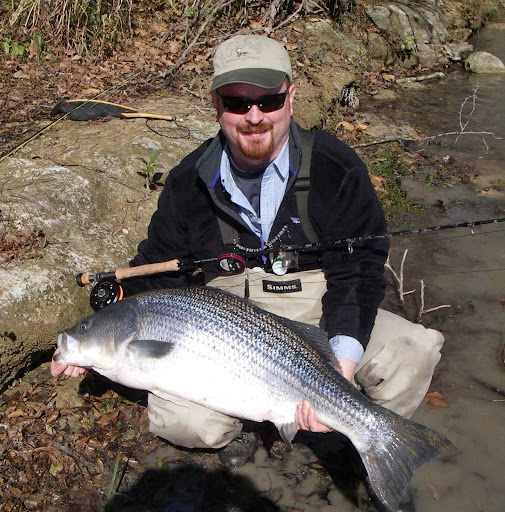
Uncle Elmer was right, after all: fly fishing is about communing with the water column. Turns out that's all I ever really wanted to do anyway.

Friday, December 22, 2006

The river is calling

Actually, I think it's the stripers I hear. Or maybe the trout. They have tiny, tiny little voices, the trout do, with a trace of a midwestern accent.

I have some free time ... starting in about an hour, when work for the week is officially over, and I thought perhaps I'd go home and do some housecleaning and maybe curl-up with a book and a cup of tea for a while. But ...

But tomorrow is going to be cold and wet, and today is sunny with a high of 67 and there's already a boat on top of my truck and I think I'll fish while I can.

Fishing, even when not catching, is for me a form of therapy. Pretty cheap therapy, even when you factor in the cost of gas, flies, rods and reels ... the more I do it, the cheaper it becomes (on an hourly basis, I mean).

Maybe I'll stop in at Cabela's, visit with RW and Jason and Ryan and Dan ... see what folks have been catching and put some line on my new 5wt outfit.

If I fish for twice as long this afternoon, or maybe go again tomorrow, that should even-out the cost, right?

I'm going to have to come up with a name for "fishing-as-therapy." Not gestalt therapy, not Freudian analysis .... When I go fishing with folks from work, we call it "single-line sampling," and "resource assessment."

If you have any ideas, post 'em in the comments below, will ya?

In the meantime ... the river is calling. Gotta run.

Monday, December 18, 2006

A book deal

Well, the big news this week is a contract to write FalconGuide's "Paddling Texas." I'm still a little floored by the whole thing.

They seem like nice folks with a great line of guide books and they're actually going to pay me to kayak the state's inland waterways. Okay, they're not going to pay me a lot, but you gotta start somewhere, right?

It's funny how things work. This actually isn't my first book deal. A couple of years ago I was going to write a wadefishing book. That fell apart with the rest of my life post-divorce, and I've been kicking myself ever since.

So this sort of feels like a second chance, a shot at redemption. And, oddly, I was pretty sure I was going to be writing a paddling book this year, I just wasn't contemplating this book.

Everything just kind of fell into place ... from the time I sent the first e-mail to the aquisition editor (also the founder of Falcon Press) until the time he put the contract in the mail, something like 14 hours had elapsed.

The book I thought I was going to write this year was a coastal kayaking book, a follow-on to a Texas Sporting Journal series that will take me from Boca Chica to Sabine Pass. And, ironically, Globe Pequot (the press that owns the FalconGuides imprint) was on my very short list of publishers to contact ....

So maybe I'll be writing that book, too, after all.

However it works out, I'm profoundly grateful for the opportunity. I'm going to be doing a loooooot of paddling over the next 12 months. Which means 2007 is probably going to be a pretty good year.

Sunday, December 17, 2006

Pleasant day on a pleasant river

For only the second time in my life, I was late for the launch of a fishing trip yesterday. I hate that.

I've gotten used to the sort of peculiar way time stretches and warps in my life, delivering me late to meetings and destinations.

It's a personal oddity. Or maybe some sort of rip in the fabric of relativity specific to ... oh, hell; often I'm just not very punctual.

Except for fishing, especially when I'm meeting people.

The plan was to put in at the Canyon Dam tailrace and float down to 4th Crossing on the Guadalupe River. It's that time of year -- trout time -- and TPWD is stocking every week. Trout Unlimited has been stocking the "special regulation" zone since November.

And, two weeks ago, John Erskine landed the new fly fishing state record striped bass from a pool below 4th crossing.

Reading his account, you get the feeling he earned that fish over the last decade or so.

So, despite the low water and slow flow (only about 60 cubic feet per second, or one-third of "good" flow), hopes were high. Mine were, anyway.

But by the end of the day, I'd seen just two fish: one clutched in the talons of an osprey, and another in the beak of a kingfisher.

That says something else about the day, though, doesn't it?

The osprey and the kingfisher I mean ... It was a lovely day, and despite the nearly solid residential development along about four of the first five miles of the Guadalupe below the dam, it's still a pleasant river with some surprises.

One of those surprises was the fellow who came down to the water, coffee in hand, and asked me and my cousin Ray what we were fishing for.

"Something with fins," I think I answered.

He then stood on the bank and pointed out the areas where he'd seen trout rising and another spot where a lunker smallmouth makes its home. He didn't have to do that, and it was a nice gesture.

Even the signs along the bank warning river-goers not to exit the water on private property are polite.

One thing the Guadalupe between Canyon Dam and New Braunfels is not is wild.

There's some wildness here, to be sure, but there are simply too many homes and too many raft and tube outfitters lining the banks to pretend you're in the middle nowhere.

I first visited this river as a middle-schooler, camping along its banks with my friend Steve's family. It was early spring, and we caught trout as I recall.

I've paddled a lot of Texas water since then, and I find that my preference is for places a little more remote.

But the Guadalupe is fun. It's a pretty river, mostly well-behaved so long as the dam holds, and ... well, I'll say it again: pleasant.

And since there are a few more trout-fed stripers in there, I reckon I'm going to have to return. Soon.

Monday, December 11, 2006

Misty day on Town Lake

Okay, I was just kidding. You didn't really think I was going to quit posting, did you?


Central Texas weather has been a bit sketchy lately; after months of wishing for one cool day, I'm ready for summer again.

Yesterday, I just had to get out of the house. Despite a light mist and a temp hovering around 50 degrees, I decided to go for a paddle. And heck, if I'm going to dump a boat in the water, might as well take a rod and reel along with me, right?

Turned out to be lovely paddling weather when I put in at Redbud Isle Park, just below the dam ... I entertained myself watching a couple of kingfishers and a blue heron (they always put me in mind of crochety old men).

Coming around the island, I saw a likely looking spot against the north bank of the channel and on my third cast hooked up with the little fella pictured at right. A bit farther upstream, I coasted into a shoal of bait and on my first cast hooked the second fish.

As I was fighting the second fish I could see several other bass chasing the baitfish ... one with the tail of what looked like a shad hanging out of his mouth. It was an unlikely afternoon to go for a paddle, but I'm glad I went.

Friday, November 10, 2006

Slacker's tight line leads to riches

[This story was first published in Lone Star Outdoor News.]


Al St. Cyr has finally graduated. At first glance, it’s a stunning accomplishment. The 24-year-old, on-again, off-again student had – effortlessly – molded himself into that proto-Austin phenomenon: the slacker.

Richard Linklater, who popularized the term in his 1990 film of the same name, has lamented in print that the term “slacker” (“one who shirks work or responsibility,” according to the American Heritage dictionary) is used in such a negative way.

“It’s a film of 100 people, and they don’t work, and they don’t do anything,” he told an Austin Chronicle interviewer in 2001. “And my whole point was: No, they do a lot. A lot of people in the film, they’ve all got their projects, they’ve all got their activities.”

Al’s project, his activity, is fishing. Carp fishing, to be specific.

“I was briefly a student, before fishing season started,” he says. Learning, he liked. It was the sitting in class while the fish might be biting that put a damper on things.

His family – happily at first, and less happily as time went on -- supported him. Maybe, in part, because they somehow thought he was still … well, in school or something.

His grandmother in particular, says girlfriend Sally Malone, was after him to graduate, get a job. One or the other. Both, if he could manage it.

Sally, who works a regular 40-hour week at a busy downtown law firm, says the quiet, lanky young man was up-front with her from the beginning.


“He told me: ‘I fish. You’re going to have to accept that,’” she says. “And it was okay, because he was just so sweet.”

She’s supportive, if not enthusiastic. Sometimes – especially in the early days -- Sally tagged along with her boyfriend.

“It’s nice, to sit by the lake and read and talk,” she says. “It’s a good way to get to know someone.”

On the night Al graduated – at the penultimate moment, in fact, as he stood on the cusp of his new life – he was on the phone with Sally. She had just left work and wanted to know if he needed anything.

“Yeah, bring me a monster taco and a Mountain Dew,” he remembers telling her.

A little while earlier – 15 minutes earlier, maybe – he’d been awakened by a couple of “bleeps.” That’s the sound the bite alarm on his fishing rod makes when the line moves.

It was the next-to-last day of a six-day carp fishing tournament on Lake Austin, and Al had moved his hundreds of pounds of gear 11 times. He was wiped-out. Crashing at midnight and getting up at 4 a.m. was really taking a toll.

Earlier in the week, a rumor had swept the contestants that Al was dead – drowned when his inflatable boat, loaded with about 200 pounds of bait, capsized in a thunderstorm.

Sally heard the rumor and called to verify: “Are you dead?” she asked.

“No, just stuck,” Al told her. Wind and water had conspired to trap him behind an island, hundreds of yards from shore. It would take about two hours for him to make it back to dry land.

Now, though, it’s the next-to-last day of the tournament. The alarm goes off. Al rises from his nap, reels into the fish and begins fighting it to shore. It’s a big fish. Maybe the record-breaker, the one worth a cool quarter million dollars. The one every angler in this American Carp Society event is hoping to catch.

Just under his rod tip, the fish wraps up a dead tree in the water. The line goes slack. Al’s phone rings. It’s Sally. He sets the rod down and places his fast food order.

After he hangs up, he pulls “for the break.”

“I was just trying to break the line,” he recalls. “Then, I felt it move a little bit and could tell the fish was still on there. I saw how big it really was and I went crazy. I started screaming and yelling. Believe it or not.”

The “believe it or not” isn’t rhetorical, not if you know Al. With his Prada shades and casual, slightly unkempt clothes, he possesses the effortless cool that teenage rebels aspire to. It’s not hard to picture him dong something with intense, even fierce, concentration. Like fishing. But it’s a stretch to imagine him jumping up and down in excitement about anything.

After the 43.125-pound common carp was weighed, released and duly certified as the new Texas state record, Al got a check. It was his first real payday in a long time, and it marked a turning point.

The richest prize in catch-and-release carp fishing history – and however nascent the sport is in the U.S., Europeans have been carping for centuries – instantly made Al a professional.

He had graduated, finally, from the ranks of the many avid, if accomplished, amateurs to the rarified world of those who are paid to fish.

Has that changed his life?

“Not at all,” he says, after a thoughtful pause. “I guess I really was a slacker. Now I’m just a slightly wealthier slacker.”

A slacker some previously skeptical family members are now proud of, by all accounts. A slacker who says his hard-won windfall will just give him more freedom to do what he loves most.

“Carp fishing basically is my life,” Al says. “It consumes most of my thoughts.”
For more on carp fishing, see this post.

Queen of rivers

Sneer not, ye tournament bass angler. Have some respect, kayak fisherman. And thou, O Master of the Long Rod, tip your hat to he who angles after the “golden bone” from the bank.

Carp, and the men and women who pursue them, suffer from an image problem. It’s an image problem based on a little bit of truth (yes, the hardy common carp can tolerate waters that will float other fish belly-to-the-sun), and a whole lot of myth (carp are scavenging sucker fish of no table or sporting value).

The truth is, the common carp (an overgrown member of the minnow family native to Asia) are edible, abundant, feisty, and -- at least potentially -- really, really big. They are omnivores that feed throughout the water column, and the big fish prefer clear, clean water.

Carpers pursue the large specimens for the same reason anyone wets a line: it’s a good time.

“It’s real easy to call them a trash fish if you haven’t caught one,” said Brian Nordberg, a Dallas resident and president of the international Carp Angler’s Group.

Usually, Nordberg said, an angler’s first carp is an accident.

“They think: ‘Wow, that was fun,’” he said. “Then maybe they go out and try to catch a big one.”

In the United States, the big ones famously occupy two bodies of water: the St. Lawrence River in upstate New York, and Town Lake in Austin.

Izaak Walton gave an entire chapter over to carp in his 1653 The Compleate Angler :

"The Carp is the queen of rivers; a stately, a good, and a very subtil fish ... the Carp, if he have water-room and good feed, will grow to a very great bigness and length; I have heard, to be much above a yard long.

"... If you will fish for a Carp, you must put on a very large measure of patience, especially to fish for a river Carp: I have known a very good fisher angle diligently four or six hours in a day, for three or four days together, for a river Carp, and not have a bite."

Al St. Cyr, who holds the current Texas state record for common carp, got hooked on the subtleties of carp-fishing years ago when he saw a fisherman catch one – by accident – while fishing for white bass near his Denton home.

“It took him so long to get it in, I just thought it was the coolest thing,” he said.

St. Cyr estimated he has caught something on the order of 50,000 carp in his fishing career. Lately, they average about 26 pounds each.

Like many anglers, St. Cyr fishes pursues carp by choice. He’s an experienced fisherman, with five bass better than 13 pounds (two from Lake Ray Roberts and three from Lake Fork). He hooked his personal best bull shark while swimming a bloody bait over the third bar on a Texas beach.

“Probably not the smartest thing to do,” he admitted.

Dedicated carp anglers can spend $5,000 or more for specialized equipment, most of it imported from Europe. A basic, three-rod set-up can be had for about $500. Long rods and spinning reels are the order of the day. A budget angler can get started with an Okuma Baitfeeder reel and Cabela’s Predator casting rod for about $120.

Nordberg said that “Euro-style” carp anglers routinely cast their baits 80-100 yards.

St. Cyr, he said, is “a monster.”

“Al has the technique, and he’s not afraid to push his equipment to the limit,” he said. “It’s not unusual for him to cast 150, 160 yards.”

Carp baits, called “boilies,” can run $10-$20 per pound. Given that a carp angler may use 200 pounds of bait in a tournament, it’s not surprising that many make their own. Recipes -- with ingredients like bananas, pineapples, Big Red and more – are closely guarded secrets.

In Texas, as across the nation, carp angling is on an upswing.

In what may have signaled a “back to the future” scenario, Texas Parks and Wildlife Department Inland Fisheries Director Phil Durocher briefed TPW Commission members in April on the status of the fishery.

The agenda item posed the question: “Fishing for Common Carp – Is This the Future for the Urban Masses?”

“The potential for carp fishing is considerable,” said Durocher. “We need to be prepared in Texas if the sport takes off.”

Common carp were introduced into the state in 1881, and Texas’ first fish hatchery – at Barton Springs in Austin – was devoted to the species.

Carpers take the disdain of their fishing brethren largely in stride.

“I just think they’re ill-informed,” said St. Cyr. “You’ve got to respect everyone’s opinions, but if they’re opinions are founded on nothing, you have to let it go.”

The Carp Anglers Group president agreed.

“Right now, we're thrilled there's some newfound respect for the species and they're beginning to be noticed as a fun and challenging sporting resource,” said Nordberg.

For more information:

Carp are indisputably the most popular game fish in the world. In the United States, two organizations promote the sport. The Carp Anglers Group is a non-profit organization that focuses on education. The American Carp Society, which sponsored the Texas Carp Challenge – the venue for St. Cyr’s state record catch – is a for-profit organization that focuses on competitive carp fishing. Both associations offer a wealth of information for anyone interested in getting involved in the sport.