Showing posts with label politics. Show all posts

Saturday, January 06, 2007

Conservationists and environmentalists

In the Fall 2006 issue of Nature Conservancy Magazine, Hal Herring revealed that hunters and anglers might also be conservationists:

"To be sure, many members of the self-described hook-and-bullet community don’t look like stereotypical environmentalists. It’s no secret, and no wonder, that hunters and nonhunting environmentalists often make each other nervous.

"But what may come as a surprise is that sporting and conservation groups, including the Conservancy, frequently turn to each other as partners. And while they may not see eye-to-eye on every issue, what connects them is an understanding that healthy ecosystems mean healthy habitats for game animals."

I think maybe the tree-huggers are more surprised than the so-called "hook-and-bullet" crowd.

Hunters and anglers, in my experience, typically are conservationists. Whether that's out of some narrow self-interest (Ducks Unlimited purchases thousands of acres of wetlands and protects it to boost the numbers of migratory waterfowl) or genuine appreciation of the natural world for its own sake ... well, who knows?

Maybe a little of both.

It's a chicken-or-the-egg question for me. I can't remember if I first wanted to fish so I could be on the water, or if I wanted to be on the water so I could fish.

I do remember the first time I spent an entire morning in a duck blind watching an osprey work for its breakfast and enjoying the sight of late-season bluebills and buffleheads alighting in my decoys. I didn't fire a shot that morning.

So what's the difference between an environmentalist and a conservationist? According to Webster's, the respective objective definitions are pretty similar:

Environmentalism: 2 : advocacy of the preservation, restoration, or improvement of the natural environment; especially : the movement to control pollution

Conservation: 1 : a careful preservation and protection of something; especially : planned management of a natural resource to prevent exploitation, destruction, or neglect

Subjectively, I'm much more comfortable being called a conservationist. A conservationist, in my mind, recognizes human needs in the environment. An environmentalist, perhaps, may not.

Other than those vague connotations -- and I'm not at all sure I'm right -- I really don't know what the difference is.

Thoughts on this? Let me know.

Sunday, November 12, 2006

A bit more war and peace

Well, that last post and a long, quiet weekend at home got me thinking. It took me back a decade and more, back to Bosnia-Herzegovina ... and it reminded me of the reception we (U.S. soldiers) got as we traveled around the country.

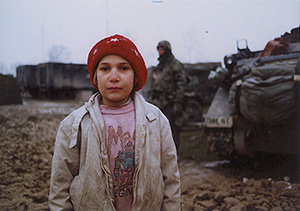
What is it with kids and G.I.s? In most places, even in areas that were controlled by the largely hostile Bosnian Serbs, children would run out to wave at a passing convoy, would surround soldiers as we got out of our vehicles, would try their few words of English and ask for "bon-bons."

In some places, often in the Bosniak or Muslim areas of the country, adults would approach to thank us for coming, for stopping the war and giving them a chance to rebuild their homes and their lives.

In some places, again usually in Srpska, we were met with sullen stares, profanities and threats.

Kids are kids are kids, and the swarms of young Bosnians always lifted our spirits. They reminded us of home, I guess, and also gave us some sense that what we were doing was worthwhile.

My feelings when speaking with the adults were more complicated. In the face of their heartfelt gratitude, their friendliness and offers of hospitality, I most often felt ... ashamed.

I remember distinctly President George H.W. Bush telling the nation, during the first Gulf War, that our involvement wasn't about oil, it was a stand against agression.

He said it repeatedly, but here's just one instance. In Oct.. 1990, at a fundraiser in Burlington Vermont, Pres. Bush said:

"You know what happened in Kuwait the other day? Two young kids, mid-teens, passing out leaflets -- Iraqi soldiers came, got their parents out and watched as they killed them. They had people on dialysis machines, and they ripped them off of the machines and sent the dialysis machines to Baghdad. And they had kids in incubators, and they were thrown out of the incubators so that Kuwait could be systematically dismantled. So, it isn't oil that we're concerned about. It is aggression. And this aggression is not going to stand..."

The incubator story, by the way, was later demonstrated not to be true. And the argument that our government's military intervention in Iraq -- then or now -- was not about oil is nonsense (see this story at Slate.com for more).

But back to Bosnia. In 1992, the United States got a new president and Bosnia was plunged into the bloodiest fighting Europe had seen since World War II. Over the next four years more than 100,000 citizens of the former Yugoslavia would die in Bosnia, and many hundreds of thousands of people were displaced under a policy called "ethnic cleansing."

The atrocities committed in that war, predominately by Bosnian Serb forces, were truly horrific. In Srebrenica, Bosnian Serbs rounded-up some 8,000 men and boys and massacred them. Captured combatants -- and sometimes civilians -- were held in concentration camps. The Serbs engaged in systematic rape of Bosnian women. Rape, as a policy of warfare.

In America, we watched the reports on CNN and listened to the BBC and clucked our tongues and shook our heads sadly. But it took three more years before we finally sent in Air Force jets and bombed the Serb artillery beseiging Sarajevo. Shortly thereafter we strong-armed the Bosnian, Serbian and Croat leaders to the peace table at Dayton.

Half a year later I was in Bosnia.

Meanwhile, Rwanda experienced a start-and-stop civil war that, in the spring of 1994, erupted into full-scale genocide. Estimates of the number of Rwandans massacred in a few short months range from 500,000 to one million.

Again, we watched it on the news, but did nothing very useful.

In neither instance, Bosnia nor Rwanda, were critical U.S. economic interests immediately at stake. And, let's be fair, oil is important ... it lubricates the entire American economy, literally and figuratively. Jobs and families' livelihoods depend on it. And maybe that's a good enough reason to go to war -- let's just be honest about why we're doing it.

I'd like to think I went to Bosnia because my country was committed to relieving suffering, to human rights, to the pledge inscribed on the wall at Dachau: "Never again."

I suspect that, in the end, our intervention in Bosnia was mostly a bid to resuscitate a flagging NATO -- a military alliance whose reason for existence had collapsed with the Berlin Wall.

At any rate, I was often proud of what we were doing there -- I thought it worth my time, worth my small sacrifice. But sometimes the gratitude of everyday Bosnians, the victims of the West's long indifference, shamed me.

Here's another view on it, written (and later performed) by a British Army officer during his tour of duty in neighboring Kosovo -- same fight, same methods, same part of the world -- a few years later.

And I'll stop it with the YouTube videos. I just figured out I can import them into the blog .... but this will be the last. For a while.

[Images courtesy DoD and Cesar G. Soriano. For an excellent and very readable overview of the U.S. Army's involvement in the Balkans, see: Bosnia-Herzegovina: The U.S. Army's Role in Peace Enforcement Operations 1995-2004]

War and peace

Yesterday I received a card from a friend, thanking me for my service to our nation. Several thoughtful cousins and uncles sent e-mails ... it's a Veteran's Day tradition in my family, to remind each other that donning a uniform still means something.
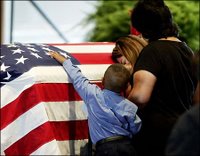
I'm not the kind of guy who wears his feelings on his sleeve, but these things bring tears to my eyes every time: a heartfelt rendition of the national anthem; a military funeral; photographs of soldiers departing for a war zone; photographs of soldiers coming home.

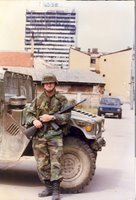
My service was not heroic. I have a drawer full of decorations, but they're all of the "been there, done that" and "hey, you did a pretty good job" variety. In Central America I helped clean up the mess Hurricane Mitch left behind. In Bosnia, I spent nine long months helping enforce an uneasy peace, then went back a couple of times just for the heck of it.

On five widely separated occasions, my military leave and earnings statement reflected an extra $150 for serving in a combat zone, but I never saw combat.

I've seen the aftermath of combat, to be sure. And I've witnessed the evidence of genocide. I've picked my way through minefields one careful step at a time; I've ducked at the sound of AK-47s on full automatic. But, so far as I could tell, those weapons were never aimed at me.

My experience in uniform in many ways was very different from my cousin Mikey's ... Mikey, a small, wirey Cajun and one of the sweetest guys you'd ever hope to meet, spent a large part of his tour of duty in Vietnam with a flashlight in one hand, a .45 in the other, searching out the enemy in a warren of tunnels.

I can only imagine how terrifying that must have been, and the courage it took to do that particular job.

The men and women serving in Iraq right now are in a no-shit war. Every day they go outside the wire, they can be sure that someone is going to try to blow them up or take a shot from a sniper's hide high over the street.
What I have in common with them, and with Mikey, is ... well, not much, probably. But there is this: the central feature of military service is the complete abnegation of the service member's will.

We call that order and discipline; it doesn't much matter if you'd rather not go down that tunnel. If your platoon leader says go, you go. It doesn't much matter if you'd rather not join a foot patrol through Sadr City. If you're told to saddle-up and hit the street, you go.

It doesn't matter if you're a reservist with a life and a job and a family; when the deployment order comes and you're sent off to some godforsaken corner of the world for close to a year, you go.

When a service member takes that oath and dons that uniform, he or she gives up the ability to choose. That sailor or Marine or airman or soldier doesn't have the luxury of saying "yes" to this war or operation or patrol, and "no" to that one.

No matter one's personal feelings about the rightness or wrongness, the effectiveness or usefulness, of an assigned duty, one acquiesces. It's what you do when you've signed on to become part of the terrible, swift sword of your nation's foreign policy.

To my mind, that implies a sort of social contract. Politicians, who decide when and where and how to employ this nation's armed forces, have a moral obligation to do so wisely -- to do so judiciously, for only the clearest reasons and in accord with whatever values we can all agree we share.

The civilian leadership in this country has an obligation to provide the military with the tools it needs to do its job. Those leaders also have an obligation to make sure the sacrifices our men and women in uniform make count for something ... that they're not in vain.

It's a tall order, and a heavy burden. But no heavier than a year on the ground in Iraq, or a year in the tunnels of Vietnam.

I am troubled that so few of the members of Congress -- about one quarter, today -- have themselves served in the armed forces. Even fewer of their sons and daughters go to war ... or peace.

It should be no surprise that military service in the United States peaked during the mobilization for World War II. Some 76 percent of American men today between the ages of 70 and 74 are veterans. Less than 10 percent of men under 30 are veterans.

In 1994, for the first time, the percentage of veterans in Congress dipped below the percentage of veterans in the population at large.

Historically, military service was a prerequisite for high political office in this country. It should be, still.

Vice President Dick Cheney, a former Secretary of Defense, has been quoted as saying that, during the Vietnam War, he "had other priorities."

Congressmen and senators and presidential advisers should know first-hand, should feel in their bones, what their antiseptic decisions in a hearing room or office in Washington mean to the young men and women in uniform.

Often enough, those decisions mean life and death.

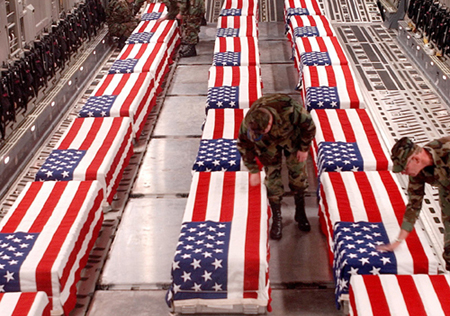
In 2004, a civilian employee at Dover Air Force Base (whence nearly all overseas casualties arrive home) sent a photo of a flag-draped coffin to a newspaper. A Freedom of Information Act request ensued, and hundreds of like photos were released to the public.

That was a mistake, according to the Pentagon, and the U.S. Senate shortly thereafter joined the Bush Administration in banning the release of such photos.

Ostensibly, the reason was to protect families' privacy. That, of course, is as absurd as it is transparent.

Sen. John McCain, a thoughtful veteran, put it this way: "These caskets that arrive at Dover are not named; we just see them," he told the New York Times. "I think we ought to know the casualties of war."

In the national discussion about whether or not our military interventions are achieving our government's policy; as we debate what that proper policy should be; as we count the enemy dead and the civilian casualties; as we tally the costs of war and peace, we should never lose sight of the human cost paid one soldier -- one mother, father, daughter, son -- at a time.

It may be that we, as a nation, agree it is a fair trade; we may count the cost acceptable. But we owe it to our troops -- the living and the dead -- to add each forfeited life, each broken family, every orphaned child into that equation.

However that math comes out, there is no doubt in mind that we owe our men and women in uniform -- those who serve today, and those who served before -- our heartfelt thanks.

Thursday, November 09, 2006

The name game

Getting ready for work this morning, I tried desperately to remember the last name of a colleague, TPWD's aquatic education coordinator. I know her well, work with her frequently, but found myself muttering: "Ann .... Ann ...."

Just wouldn't come to me.

Our email address list at work -- the "global" we call it -- is artfully arranged and alphabetized by first name. Purposeful? I'd like to think so. I' d like to think one of our IT whizzes consciously decided to humanize our bureaucracy by forcing us to correspond with our colleagues on a first-name basis.

That's probably wishful thinking on my part, though a sort of collegial informality does reign in my workplace.

There are, I think, cultures of address; ways of naming and addressing the people with whom we come in contact that vary widely based on history and tradition, relationship and age, geography and status.

In my youth, I "sirred" and "ma'amed" anyone old enough to vote. My parents insisted on it, as their parents had taught them, ad infinitum into the dim mists of history, I suppose.

Friends' parents were always addressed by their last names preceded by an honorific: "Mr. Sbrusch," and "Mrs. Friebele." Never mind that they may have been so familiar with us, known so long as to be nearly surrogate parents.

That became something of a sliding scale; as I grew older, the minimum age of an individual deserving of formal address also shifted. Though old habits do die hard; I would still find it difficult, I think, to call Mr. Sbrusch "Frank," or Mrs. Friebele "Betty."

In some distinct social milieu, even within this broad "culture" we mistakenly assume to be monolithic, forms of address are quite different from what I sometimes expect. An elderly black couple I once knew referred to each other -- in each other's presence -- formally: "Mr. Jones crushed his foot under a refrigerator," the wife might tsk.

I don't know enough to divine whether that is a "black" thing, an old-fashioned thing, a southern thing, or just some thing my particular white trash background didn't adequately prepare me to recognize.

In the Rio Grande Valley, hard on the Mexican border, formality also is the rule rather than the exception. Office workers dress like professionals and supervisors and strangers often are referred to -- and addressed -- by title and last name.

Spanish and other Latin languages of course allow a little more room to maneuver. In both the second and third persons, one may signal the nature of a relationship by the use of the proper pronoun.

English, on the other hand, has largely divested itself of the formal and respectful "thou" and "thine." We use the all-purpose "you" for everyone from the President to the kitchen help, for siblings and strangers alike.

In the military, informality trickles down the chain of command, but rarely up. A major might call a captain or even a sergeant in his command by his first name, but barring a pre-existing relationship (say, for instance, they were Cub Scouts together) or a whole lot of off-duty fraternization, it's unlikely the subordinate will call his superior by his first name; certainly never in public.

The Commander-in-Chief, of course, can call anyone anything he likes, and frequently does. Pres. Bush has dubbed poor Karl Rove, alternately, "Boy Genius" and "Turd Blossom."

This week, I suspect, he's answering to the latter.

Former FEMA Director Joe Allbaugh was "Big Country," and the president's own father was dubbed by his son "Forty-one." Michigan Republican Rep. Fred Upton, to the president, is "Freddy Boy;" Rep. Dennis Hastert, until this past Tues. third-in-line in presidential succession, was simply "Speak."

Dana Milbank of The Washington Post, a long-time critic of the Bush administration, allegedly is referred to by the chief executive by a name Milbank says is "unprintable in a family publication." Some reports say the president calls Milbank "Chickenfucker."

Ouch.

Reportedly, "Forty-three" refers to the president of Russia as "Pootie-Poot." That's almost mind-boggling to me; that the head of state of one nuclear nation refers to the head of state of another in baby-talk.

But I suppose you can do that when you lead the sole remaining superpower. And that's probably the point.

I answer to a couple of nicknames, "Schlop" and "Running Dog" among them. Neither arose out of particularly flattering circumstances, but as they were assigned by my friends and peers -- who bear their own, equally laughable appellations -- it's okay.

Boston psychiatrist Ronald Pies, M.D., makes a persuasive argument that George W. Bush's penchant for assigning nicknames to friends, foes and staff members is much more than good-natured frat boy ribbing. It is, Pies argues, an assertion of dominance. It's Alpha male behavior, dick-measuring taken to an extreme.

On the one hand, it's flattering to be close enough to the president of the United States that he calls you anything more than once; on the other hand, who can possibly gainsay the leader of the free world when he calls you something outrageous?

"Nicknames," Pies writes, "serve an important function of dominion for all of us ... they define and delimit another's powers and status. Nicknames put people in their place(s)."