Showing posts with label society. Show all posts

Tuesday, February 19, 2008

Fossickers

Fossicking is a term found in Cornwall and Australia referring to prospecting. This can be for gold, precious stones, fossils, etc. by sifting through a prospective area. In Australian English, the term has an extended use meaning to "rummage". The term has been argued to come from Cornish. -- Wikipedia

Last week Tam and Patrick and I trouped down to the AGMS building on Burnet Lane for the monthly meeting of the Paleontological Society of Austin. I can barely say "paleontological," (seven syllables, count 'em), so I just call it "the paleo club."

Sometimes they refer to themselves as "dirt diggers."

We paid a whopping $20 for a family membership, and I think -- between the featured presentation and the expert IDs of some oddball specimens -- we got our money's worth the first meeting.

Good people. No surprise since, as my buddy Vince says, you can tell a lot about someone by how they feel about rocks. I was pleased to see Paul Hammerschmidt, a TPWD coastal fisheries biologist, there. Paul and I -- along with his son and some other folks -- went rock-hopping together at South Padre Island during the Texas Clipper sinking event. Nice guy with the kind of all-encompassing curiosity and enthusiasm that I identify with the very best scientists in any field.

Vince's office-neighbor Bill Kidd was there as well -- he and his wife are regulars -- as was Vince himself, with two of his daughters.

I heard the term "fossicking" for the first time twice in one night, from two different people. I like it; to my ears, it has overtones of "frolic" and ... well, it's just a fun word.

That was back in ... January, at our Twelfth Night party. Aimee, my cousin Geoff's geologist wife, gleefully sang out the word when I showed her some recent find. She had picked it up while fossicking in Australia.

Later in the evening, my friend Dub, also a geologist by trade, said: "Man, you guys have really been doing some fossicking ..."

Dub arrived after Aimee and Geoff left for the evening, and brought with him a housewarming gift of a beautifully cleaned and preserved exogyra ponderosa. It's the single best housewarming gift anyone has ever given us, and sits on the mantle now.

On the way home last Tuesday, Patrick broke a short silence with: "Daddy, that was fun!" It probably didn't harm his appraisal of the event that he left with a box full of give-away fossils (including some small ammonites and some very cool gastropods ... er, snails).

Sunday, June 03, 2007

Renaissance

Confession: Secretly, I want to be a Rennie. Or maybe, more accurately, I want to have been a Rennie.

A "Rennie" is someone who participates in Renaissance festivals, also known colloquially as "faires" or "shows." There are scores around the country -- two big ones of longstanding in Texas -- and they are, in aggregate, an absolutely fascinating subculture.

I'm not certain I have the chronology right, but I think it goes something like this: in the 1970s, a California educator put on a weekend-long "market" festival with an emphasis on artisanship. It was sort of an outgrowth of back-to-basics hippie self-sufficiency, a reaction to the plasticization (in the sense that Ruben Blades uses the word "plastic" in his song of the same name) of late-20th-century American culture.

Over time, Ren faires grew to offer period costumes and performances, vendors offering an amazing array of arts and crafts and demonstrations of everything from soap-making to blacksmithing to glass-blowing.

At a Renaissance festival, visitors are likely to see everything from jousting demonstrations to pub wenches to mud beggars to virtuoso performances on the hammer(ed) dulcimer. It's modern-day vaudeville, with knife-throwing, puppetry, juggling and comedy routines that sometimes reach a level of sophistication and polish seen nowhere else. The Flaming Idiots got their start at Ren faires.

Historical accuracy apparently is not a strict requirement. There's a good deal of schlock, and more than a few anachronisms, mixed in with the art and period pieces.

Visitors will also see lots and lots of costumes; some are period (14th-17th c.) costumes, faithfully reproduced and worn. Others are complete flights of fancy, or -- more accurately -- fantasy. Like the gentleman in bright blue leather armor and Justin roper boots I saw opening weekend at Scarborough.

The phenomenon has given birth to its own jargon, as true subcultures must; my 8-year-old son is, for now, a "playtron." A patron who comes in costume. It's not a stretch for a boy who is, predictably, enamored of knights and castles, swords and wizardry. The Lord of the Rings and the Harry Potter movies weren't blockbusters for nothing.

I was vaguely aware of the Texas Renaissance Festival and Scarborough Faire. More than vaguely, truthfully; I had a secret yearning to go and see and participate.

Two developments recently have made this possible.

The first, of course, is Patrick's interest. Where else is he going to be able to spend a day in his knight costume and test his jousting skills on the quintane? Where else will he be addressed, dozens of times throughout the day, as "m'lord?"

At Scarborough last weekend he was recruited, on the street, by an enterprising Borgia who offered him 50 gold florins to kill Oliver Cromwell. It was a genius strategy, I thought: after all, who would suspect an innocently smiling, tow-headed 4-foot assassin? Even if he does go by "Sir Patrick the Sinister." (At the risk of giving away his advantage in swordplay, it's because he's left-handed.)

Patrick experienced a Renaissance festival -- TRF near Houston -- before I did. In the end, though, his interest could simply be another of those things parents tolerate to humor their kids.

My other entree into the Ren world is in some ways more significant.

Renaissance is a vital part of Tamara's enchanting story. For more than a decade, she "did the circuit," a series of shows that kept her on the road and engaged in an earthy, hippie art and performance culture six months out of the year.

Today she has a highly responsible and remunerative position with a successful Austin software company. She's come to treasure things like indoor plumbing, air conditioning and -- lately -- down comforters. She's happy to have health insurance and a 401(k).

In some respects Tamara is pretty typical of the other Rennies I've met: bright, well-read, highly creative ... most of these folks could make a go at just about anything they turned their hands to. The shows do for them what Austin does for musicians: allows them to make a living doing what they love best in a world that too often values "counters" over "makers."

It was a big leap for Tamara, to leave the Ren world and pursue a "straight" job. Her best friends -- people she has known and loved for two decades, in some cases -- are, many of them, still on the road. A few have opted for a more settled existence. The lucky ones, in my view, manage to keep one foot in each place.

Tam has done that by working hard to maintain those relationships, making herself useful in small ways on show weekends and being very, very careful not to violate the many unwritten rules of the tribe.

Some of those rules, I think, have to do with how much access is given to outsiders, how far they are allowed to penetrate that culture.

I am an outsider. I have a straight job, have only ever held straight jobs. I don't own a costume. I am not an artist, or even a particularly competent craftsman. My last dramatic effort was a run as Ensign Pulver in a UIL One-Act Play production of "Mister Roberts."

Bringing me along as she bridges the gap between her two worlds carries risks for her, not the least of which is loss of credibility and ostracization from her tribe. For me the risk is rejection, embarassment -- the kind a foreigner feels when mistaking an idiom or violating a taboo, being responsible for somehow separating her from a part of her life that is still very important to her.

As Tamara has revealed to me, bit by bit, more of her story and given me more insights into the Ren world, I've wondered at how honestly curious I am and how easily accepting I have been of the whole fantastic hippy-pagan-gypsy-crafting lifestyle.

But as I've traded story for story, and my memory was jogged by things she said, I've finally come to see it as No Big Surprise.

Some of my earliest best memories are of helping my grandma in her shop in Rockport. A retirement enterprise for my grandparents, it was something of a typical tourist trap -- full of sea shells and postcards and (this being before China's cheap-labor hegemony) imports from Mexico.

Alongside the rusty cutlasses and faux armor and serape-draped stuffed frogs, there was some genuine craft: lampshades created from thinly-sliced, translucent stone; paper weights and toilet seats and bric-a-brac preserving anything of interest -- shells, gems, fossils ... rattlesnake rattles? -- in heavy plastic resin.

Grandma made jewelry, and between her and my Grandpa there wasn't a rock or gem in sight that didn't receive at least a couple paragraphs of exposition. Grandpa was a water-witcher and a mushroom expert, could readily find and sort the tasty from the merely edible, the hallucinoginic from the lethal. A curious skill, now that I think of it, but one he shared with more than a few Rennies, if Ray St. Louis is to be believed.

Fantasy was so much a part of my life that I just assumed everyone had read Tolkien's trilogy three times by the time they were 15, and knew who Reepicheep and Aslan were.

My first great romance was with a beautiful, free-spirited woman who didn't particularly care for shaving under her arms but knew a whole lot about writing poetry, baking bread, milking cows and making cheese. I was blessed to have the opportunity to do all of that and more over long summer and holiday breaks at her family's farm in southwestern Wisconsin.

Even before that, and continuing on for years, I worked my way into my own tribe, a loose family of seafaring sorts -- long-distance cruisers, gunkholers, boat-builders. In my part of the world they, too, had a circuit: Texas Gulf Coast, the Mexican Caribbean, the Abacos, Bermuda, the Chesapeake ... it wasn't at all unusual to run into members of my hometown sailing club (and tellingly, it was the "sailing" club, not the "yacht" club) in Annapolis, or to meet a friend of a friend on Maryland's Eastern Shore, or see a familiar boat awaiting transit in Panama.

In Oxford, Md., a tidewater town founded during the historical Renaissance some four centuries ago, I was dropped-off to repair a boat and then deliver it back across the bay to Solomon's Island. I walked into my favorite watering hole there and asked the bartender where I could reprovision. He gave me directions, then threw me the keys to his truck.

Like Rennies, sailors help each other out, no questions asked. They are independent sorts, but loyal to the tribe; reluctant to be bound to the straight world of 9-5 drudgery, jealously protective of their freedom to pick up and go at a moment's notice.

Like other subcultures, the sailing -- especially cruising -- lifestyle comes with its own costumes, jargon and set of unwritten rules. Landlubbers, stinkpotters and wannabes stick out like sore thumbs.

But among the fraternity of cruising sailors, one can gain admittance by building skills and experience. Unknown drop-ins from over the horizon are welcomed if they can talk the talk and walk the (rolling) walk. Cred is awarded for miles under the keel and storms weathered.

Rennies are sometimes derided by the straight world as "those weird, hippie people;" sailors as "boat bums."

I seem to be drawn to both clans of dropouts from the mainstream.

Tamara asked me not long ago what I would like to see happen, with regard to bridging, with her, the gap between the straight world and the Ren world. I thought about it, and finally told her that -- best-case scenario, I'd like to be adopted by the tribe. At the very least, grudgingly accepted as a harmless interloper.

I'm not sure how to do that -- not sure, even, that it's anything I can somehow achieve on my own. It's important to me, though, because it speaks to some natural affinity; also, because it's important to Tam.

Patrick offered a clue to what might be one path. After we returned from a long day at Scarborough last weekend, we sat down to build catapults from a box of woodcrafting supplies Tamara had ordered weeks earlier.

We glued and rubber-banded various combinations of tongue depressors, clothespins and other parts together -- whose will hurl something farther, higher?

Later, when I was out of the room, my son turned to Tamara and asked thoughtfully: "So ... how many of these would we have to build to fill a booth?"

Saturday, January 06, 2007

A bad hop

I know this girl, a brainy, beautiful biologist-type, who eschews violence toward other living things. Unless it's a specimen destined for scientific study. Or the occasional fish for the frying pan. Or a cockroach.

Okay, so maybe she's not the Mahatma Gandhi of the natural world. But she is the kind of person who will stop and move a turtle across the road.

A couple of months ago, driving through the Everglades, she did just that. A few miles down the road a large bullfrog blindly leaped under her moving tire, emitting a loud "pop" as it expired.

She was a bit distressed. The frog, she said, had "taken a bad hop."

The phrase kind of caught-on, and now it's shorthand for any "oops ..." or "d-oh!" moment.

Sometimes the bad hops come so quickly one on the heels of the other that I just want to hunker-down and stop hopping altogether.

Of course, sometimes I leap right into something really cool. A tasty dragonfly. A book deal. Maybe a winsome young lady bullfrog who has responded to my drainage-ditch croaking.

It happens.

Anyhow, here's wishing you plenty of good hops in the New Year.

Wednesday, December 06, 2006

There be (no) monsters here

When I was 13, my folks offered me a choice between a sailboat and a horse. Being young and naive, I opted for the boat.

Boats, I reckoned, don't need to be fed, curried and exercised.

Right.

The practical effect of having a boat at my disposal, though, was that -- suddenly -- the 80+ square miles of Aransas Bay were mine to explore.

Looking back, and as a parent myself now, I can't imagine what the heck my folks were thinking when they dropped me off at sunrise and told me to be back for supper.

Oh, yes ... "Wear your life jacket," and "Don't forget to put on sunscreen!"

PFD buckled tight, my lunch, a gallon milk jug of tap water and a fishing rod stowed below the deck ... I'd take off. Sometimes I'd take a friend; sometimes I'd sail off all by myself.

I have wonderful memories of those days ... racing summer squalls off the Gulf, climbing mid-bay oil and gas production platforms and leaping into the cool, green waters ... hunting for mammoth teeth and fossilized sand dollars on the spoil islands; catching trout near an old, wrecked barge ... pacing curious dolphins who wondered, no doubt, just what kind of creature I was.

My mom worried about me, I know, and in retrospect I think it must have been my father who greenlighted those summer expeditions. As a youngster growing up on the shores of the same bay he was the proud skipper of an old skiff powered by a recalcitrant Montgomery Ward's 7.5hp outboard.

"It would usually get me to where I wanted to go," he's often said, "And then I'd row home."

I hope that, if I still lived in Rockport, I would allow my son to do the same at age 13.

I worry about my boy, though. And in that, I am not much different than most parents in the America of the early 21st Century.

Richard Louv, author of one of my favorite books of all time, Fly-Fishing for Sharks: An Angler's Journey Across America, in 2005 published Last Child in the Woods. It's a wonderful, thought-provoking look at what we are doing to our children by separating our kids from the outdoors.

Thought-provoking because Louv brings together a growing body of evidence that suggests the rise in childhood obesity, attention disorders and depression may be directly linked to what he calls "nature deficit disorder." Wonderful because he suggests ways that parents, educators, city planners, developers and others can begin to bridge the chasm between our children and the natural world.

One of the barriers Louv identifies that is keeping parents from allowing -- insisting on -- unstructured "play" time outdoors for their children is simply fear.

It's fear of strangers and fear of natural phenomena. We're afraid of sexual predators and crazed gunmen ... we're afraid of bears and lions, snakes and sharks. We're afraid of ... we're not even sure. We're just scared.

Fear of the unknown is nothing new; it's a fundamental human condition. In the dim, dark past -- four or five centuries ago, that is -- cartographers labeled the unknown: "There be monsters here."

But are there?

Perception and reality

Much of our fear stems not from our own experiences in the outdoors, but from news media reports that are ever more sensationalized. The 24-hour news cycle has networks, newspapers and local affiliates climbing over each other to grab our attention; it allows sensational stories to be reported again and again, and in greater depth than ever before.

A mountain lion attacks a child near Los Angeles, and within days sheriff's departments across Central Texas are flooded with calls about strange sounds in the night, missing pets, and shadowy glimpses of something large and tawny amongst the cedars.

News is the out-of-the-ordinary. News is tragedy. Disaster. Conflict. We don't watch what doesn't happen on TV. We don't hear about a perfectly enjoyable day in the outdoors for the simple reason that it is not newsworthy.

Supporting the notion that false perceptions sometimes outweigh reality, Louv quotes a Children's Defense Fund report from the mid1990s that claimed: "Every year since 1950, the number of American children gunned down has doubled."

The statement was widely reported in the mainstream media, though of course it is demonstrably false.

Prof. Joe Best of the University of Delaware debunks it: Were it true, in 1983, the number of American children gunned down would have been about 8.6 billion that year. In 1987, it would been greater than the estimated total of the world's population since the advent of humanity.

So what are the dangers to our children in the outdoors? Is nature likely to be lethal, or even very harmful?

On Aransas Bay -- and I've written elsewhere that I consider the more than 3,000 miles of Texas tidewater coastline to be a true wilderness, in many respects -- the answer is probably "no" (with a few caveats).

Dangerous people

Let's look at "stranger danger" first. That's the one I worry about most in relation to my own child, a bright, conscientious, level-headed 7-year-old.

The sad truth is, my son is probably at greater risk of falling victim to a predator in a shopping mall, on a neighborhood street or even his elementary school playground than on the waters of a Texas bay.

Predators congregate where the prey is. That's why lions hang out at watering holes on the Serengetti and trout and redfish pile-up at the mouths of sloughs and guts on an outgoing tide.

Since Jean Lafitte sailed away from the Texas coast a century and a half ago, our bays have been mostly free of folks who ply the waterways with the notion of harming others.

Peter Jenkins, the man who walked across the country, piloted a 25-foot Grady White alone from the tip of Florida to the Rio Grande back in the early 1990s.

On his journey around the Gulf of Mexico, he was threatened just once, when a couple of thugs attacked him in an effort to steal his boat as he entered Aransas Bay.

That shameful episode aside, it's almost certain the worst fate a young boater might face on our bays is indifference from a visiting angler unfamiliar with local mores (and international law, come to think of it) that dictate that a seafarer must always render aid to anyone in need on the water.

Drowning

Drowning, of course, is an ever-present danger when on, in or near the water.

In 2004, 270 people in Texas died due to drowning ... they included infants in bathtubs, children in the surf, boating accident victims and families attempting to drive across swollen waterways.

By way of comparison, the flu took 3,170 lives, peptic ulcers claimed 213 and 1,040 Texans died in falls.

Many of the drownings that occurred on public waters were the result of boating accidents. A quick look at the state's statistics show the coast, though, to be relatively safe. Last year, for instance, Lakes Travis and Cedar Creek each recorded three boating accident fatalities ...

Galveston Bay, one of the busiest bodies of water in the nation, had only two. Aransas Bay and the Gulf of Mexico: none.

No doubt this has something to do with who is using the water and how they're using it. On Lake Travis, it's often college-age partiers, and fast boats and alcohol play a role. On Aransas Bay, it's anglers and sailors.

My approach to keeping Patrick safe from drowning is straightforward: I've insisted he learn to swim; he always wears a life preserver when aboard a boat and when around the surf or dangerous currents I keep a close eye on him. It's the best I can do, right now, but enough to make me comfortable that his risk of drowning is very low.

Sharks and other terrors

Remember Jaws? I do ... it kept me out of the water for an entire summer. Sharks, as very efficient and sometimes very large apex predators rightly inspire respect from those who venture into their native habitat.

In locales where people mimic sharks' natural prey -- where a surfer's silhouette looks an awful lot like a seal on the surface, for instance -- there is some slight danger of becoming un snaquillo de tiburon.

In Texas, we have neither seals nor seal-snacking sharks. Not regularly, anyhow. We do, though, have half-ton tiger sharks roaming our beaches and those suckers can wolf-down sea turtles like popcorn.

In the bays and in our nearshore waters, schools of blacktips hunt mullet and other fish, and bull sharks -- some quite large -- nose through the mud after crabs and rays and redfish.

In Texas, there have been 32 recorded shark attacks. Of those, three were fatal, and the last one of those occurred seven years before I was born.

Even factoring in the entire United States, with Florida's and Hawaii's relatively higher numbers of attacks and fatalities, an individual is 10 times more likely to be killed by a dog than a shark.

Setting aside instances of sheer stupidity and poor judgment -- sailing under the bow of a tanker in the ship channel, or launching a boat in a tropical storm -- I've concluded that the greatest danger on the Texas coast arises not from two-legged villians nor from great beasts lurking below the waves, but from a critter so small you'd need a microscope to observe it.

Bad bugs

Okay, it's not even the greatest danger ... it's just my personal boogeybug because the effects are so nasty.

Bacteria from the Vibrio family include V. cholarea, which causes cholera ... it's a real problem in developing countries but not so much here. Cholera's cousin V. vulnificus, though, touches someone I know, or a friend of a friend anyhow, almost every year.

Vibrio can enter the body either through a wound (cut, scrape, blister) or through seafood. It's a common cause of "food poisoning" from eating oysters.

About a third of the three dozen or so reported Vibrio cases in Texas each year are caused by V. vulnificus, and about a quarter of those are fatal. The bug seems to be limited by both salinity (it likes salinities lower than seawater) and temperature (infections peak in warmer months ... of course, that's when most folks are in the water, too).

Meridith Byrd, a TPWD biologist who studies harmfal algal blooms and keeps up on other little critters, like Vibrio, grew up in the Texas Coastal Bend and she says she never worries about Vibrio.

Should I be concerned, I asked her?

"Nah, not unless you’ve got risk factors: liver disorders (hepatitis, cirrhosis), diabetes, immunocompromising conditions (HIV/AIDS, cancer, autoimmune disorder such as lupus), recent gastric surgery or take antacids for an ulcer, hemochromatosis (metabolic iron disorder)," she told me. "Vibrio is not something that routinely causes problems in a normal, healthy person. Ninety-nine percent of the cases that make the news involve a victim with an already-compromised immune system."

Those cases, though, are horrific.

Two buddies go fishing in Matagorda Bay. A couple of days later each experiences swelling, and redness on extremities and suffer fevers and other flu-like symptoms. They go the hospital and one ends up losing a leg below the knee. The other dies.

Or a fishing guide notices a cut on his hand has become infected. It gets worse, and several days later he's in the hospital with the flesh rotting away from his arm (which is now split open from his wrist to his shoulder). For the next six months, he faces a repeated regimen of surgical debridement.

The killing blow, from Vibrio, is septocemia -- a condition that occurs when the bacteria enters the bloostream and causes a systemic infection. About half who enter that stage of the disease don't recover.

Despite my personal horrified fascination with this littlest monster, the good news is, it's still relatively rare to contract Vibrio. Deer kill something like 50 times the number of people who die from Vibrio in Texas each year. Furthermore, treatment in the early stages is a simple round of antibiotics.

Let us be clear: the Texas coast is in some places a remote and very harsh environment. Anyone who ventures into it should be prepared: take plenty of drinking water and wear sunscreen.

Know how to operate your vessel and wear a personal flotation device. File a float plan and, if you can, make sure you have some means of communication (cell phones work some places, but much better is a handheld VHF radio).

As for Patrick, I'll continue to educate him about the dangers above and below the water and how best to avoid them. A lot of it is just common sense.

I'll prepare him as best I can to safely enjoy the wilderness so near us. And then, I sincerely hope, I'll be brave enough to turn him lose to explore it on his own.

We're already talking about his boat ... it looks now like it will be a 10-foot, stitch-and-glue constructed dingy. He says he'll call it "Rascal."

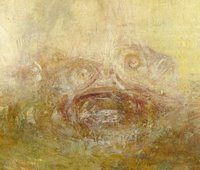
[The first image is a detail from Sunrise with Sea Monsters, by John Mallord William Turner (1775-1851. It hangs in the Tate Gallery, London.]

Sunday, November 12, 2006

A bit more war and peace

Well, that last post and a long, quiet weekend at home got me thinking. It took me back a decade and more, back to Bosnia-Herzegovina ... and it reminded me of the reception we (U.S. soldiers) got as we traveled around the country.

What is it with kids and G.I.s? In most places, even in areas that were controlled by the largely hostile Bosnian Serbs, children would run out to wave at a passing convoy, would surround soldiers as we got out of our vehicles, would try their few words of English and ask for "bon-bons."

In some places, often in the Bosniak or Muslim areas of the country, adults would approach to thank us for coming, for stopping the war and giving them a chance to rebuild their homes and their lives.

In some places, again usually in Srpska, we were met with sullen stares, profanities and threats.

Kids are kids are kids, and the swarms of young Bosnians always lifted our spirits. They reminded us of home, I guess, and also gave us some sense that what we were doing was worthwhile.

My feelings when speaking with the adults were more complicated. In the face of their heartfelt gratitude, their friendliness and offers of hospitality, I most often felt ... ashamed.

I remember distinctly President George H.W. Bush telling the nation, during the first Gulf War, that our involvement wasn't about oil, it was a stand against agression.

He said it repeatedly, but here's just one instance. In Oct.. 1990, at a fundraiser in Burlington Vermont, Pres. Bush said:

"You know what happened in Kuwait the other day? Two young kids, mid-teens, passing out leaflets -- Iraqi soldiers came, got their parents out and watched as they killed them. They had people on dialysis machines, and they ripped them off of the machines and sent the dialysis machines to Baghdad. And they had kids in incubators, and they were thrown out of the incubators so that Kuwait could be systematically dismantled. So, it isn't oil that we're concerned about. It is aggression. And this aggression is not going to stand..."

The incubator story, by the way, was later demonstrated not to be true. And the argument that our government's military intervention in Iraq -- then or now -- was not about oil is nonsense (see this story at Slate.com for more).

But back to Bosnia. In 1992, the United States got a new president and Bosnia was plunged into the bloodiest fighting Europe had seen since World War II. Over the next four years more than 100,000 citizens of the former Yugoslavia would die in Bosnia, and many hundreds of thousands of people were displaced under a policy called "ethnic cleansing."

The atrocities committed in that war, predominately by Bosnian Serb forces, were truly horrific. In Srebrenica, Bosnian Serbs rounded-up some 8,000 men and boys and massacred them. Captured combatants -- and sometimes civilians -- were held in concentration camps. The Serbs engaged in systematic rape of Bosnian women. Rape, as a policy of warfare.

In America, we watched the reports on CNN and listened to the BBC and clucked our tongues and shook our heads sadly. But it took three more years before we finally sent in Air Force jets and bombed the Serb artillery beseiging Sarajevo. Shortly thereafter we strong-armed the Bosnian, Serbian and Croat leaders to the peace table at Dayton.

Half a year later I was in Bosnia.

Meanwhile, Rwanda experienced a start-and-stop civil war that, in the spring of 1994, erupted into full-scale genocide. Estimates of the number of Rwandans massacred in a few short months range from 500,000 to one million.

Again, we watched it on the news, but did nothing very useful.

In neither instance, Bosnia nor Rwanda, were critical U.S. economic interests immediately at stake. And, let's be fair, oil is important ... it lubricates the entire American economy, literally and figuratively. Jobs and families' livelihoods depend on it. And maybe that's a good enough reason to go to war -- let's just be honest about why we're doing it.

I'd like to think I went to Bosnia because my country was committed to relieving suffering, to human rights, to the pledge inscribed on the wall at Dachau: "Never again."

I suspect that, in the end, our intervention in Bosnia was mostly a bid to resuscitate a flagging NATO -- a military alliance whose reason for existence had collapsed with the Berlin Wall.

At any rate, I was often proud of what we were doing there -- I thought it worth my time, worth my small sacrifice. But sometimes the gratitude of everyday Bosnians, the victims of the West's long indifference, shamed me.

Here's another view on it, written (and later performed) by a British Army officer during his tour of duty in neighboring Kosovo -- same fight, same methods, same part of the world -- a few years later.

And I'll stop it with the YouTube videos. I just figured out I can import them into the blog .... but this will be the last. For a while.

[Images courtesy DoD and Cesar G. Soriano. For an excellent and very readable overview of the U.S. Army's involvement in the Balkans, see: Bosnia-Herzegovina: The U.S. Army's Role in Peace Enforcement Operations 1995-2004]

Thursday, November 09, 2006

The name game

Getting ready for work this morning, I tried desperately to remember the last name of a colleague, TPWD's aquatic education coordinator. I know her well, work with her frequently, but found myself muttering: "Ann .... Ann ...."

Just wouldn't come to me.

Our email address list at work -- the "global" we call it -- is artfully arranged and alphabetized by first name. Purposeful? I'd like to think so. I' d like to think one of our IT whizzes consciously decided to humanize our bureaucracy by forcing us to correspond with our colleagues on a first-name basis.

That's probably wishful thinking on my part, though a sort of collegial informality does reign in my workplace.

There are, I think, cultures of address; ways of naming and addressing the people with whom we come in contact that vary widely based on history and tradition, relationship and age, geography and status.

In my youth, I "sirred" and "ma'amed" anyone old enough to vote. My parents insisted on it, as their parents had taught them, ad infinitum into the dim mists of history, I suppose.

Friends' parents were always addressed by their last names preceded by an honorific: "Mr. Sbrusch," and "Mrs. Friebele." Never mind that they may have been so familiar with us, known so long as to be nearly surrogate parents.

That became something of a sliding scale; as I grew older, the minimum age of an individual deserving of formal address also shifted. Though old habits do die hard; I would still find it difficult, I think, to call Mr. Sbrusch "Frank," or Mrs. Friebele "Betty."

In some distinct social milieu, even within this broad "culture" we mistakenly assume to be monolithic, forms of address are quite different from what I sometimes expect. An elderly black couple I once knew referred to each other -- in each other's presence -- formally: "Mr. Jones crushed his foot under a refrigerator," the wife might tsk.

I don't know enough to divine whether that is a "black" thing, an old-fashioned thing, a southern thing, or just some thing my particular white trash background didn't adequately prepare me to recognize.

In the Rio Grande Valley, hard on the Mexican border, formality also is the rule rather than the exception. Office workers dress like professionals and supervisors and strangers often are referred to -- and addressed -- by title and last name.

Spanish and other Latin languages of course allow a little more room to maneuver. In both the second and third persons, one may signal the nature of a relationship by the use of the proper pronoun.

English, on the other hand, has largely divested itself of the formal and respectful "thou" and "thine." We use the all-purpose "you" for everyone from the President to the kitchen help, for siblings and strangers alike.

In the military, informality trickles down the chain of command, but rarely up. A major might call a captain or even a sergeant in his command by his first name, but barring a pre-existing relationship (say, for instance, they were Cub Scouts together) or a whole lot of off-duty fraternization, it's unlikely the subordinate will call his superior by his first name; certainly never in public.

The Commander-in-Chief, of course, can call anyone anything he likes, and frequently does. Pres. Bush has dubbed poor Karl Rove, alternately, "Boy Genius" and "Turd Blossom."

This week, I suspect, he's answering to the latter.

Former FEMA Director Joe Allbaugh was "Big Country," and the president's own father was dubbed by his son "Forty-one." Michigan Republican Rep. Fred Upton, to the president, is "Freddy Boy;" Rep. Dennis Hastert, until this past Tues. third-in-line in presidential succession, was simply "Speak."

Dana Milbank of The Washington Post, a long-time critic of the Bush administration, allegedly is referred to by the chief executive by a name Milbank says is "unprintable in a family publication." Some reports say the president calls Milbank "Chickenfucker."

Ouch.

Reportedly, "Forty-three" refers to the president of Russia as "Pootie-Poot." That's almost mind-boggling to me; that the head of state of one nuclear nation refers to the head of state of another in baby-talk.

But I suppose you can do that when you lead the sole remaining superpower. And that's probably the point.

I answer to a couple of nicknames, "Schlop" and "Running Dog" among them. Neither arose out of particularly flattering circumstances, but as they were assigned by my friends and peers -- who bear their own, equally laughable appellations -- it's okay.

Boston psychiatrist Ronald Pies, M.D., makes a persuasive argument that George W. Bush's penchant for assigning nicknames to friends, foes and staff members is much more than good-natured frat boy ribbing. It is, Pies argues, an assertion of dominance. It's Alpha male behavior, dick-measuring taken to an extreme.

On the one hand, it's flattering to be close enough to the president of the United States that he calls you anything more than once; on the other hand, who can possibly gainsay the leader of the free world when he calls you something outrageous?

"Nicknames," Pies writes, "serve an important function of dominion for all of us ... they define and delimit another's powers and status. Nicknames put people in their place(s)."

Sunday, November 05, 2006

Lone Star state of mind

The hubris of Texans is legendary. "Everything," a Lone Star native might say, "is bigger in Texas."

Bigger. Better. Prettier. Nicer ... Finer. Easier. Kinder.

The stereotypical Texan wears a 10-gallon hat, boots and an attitude as big as his native state. Texans' braggadacio and self-promotion inevitably leads to a certain amount of resentment north of the Red River and east of the Sabine.

Wisconsinites might press cheese curds into the shape of their state's political boundaries, but where -- other than Texas -- do folks commonly tattoo their state's outline or symbols on their bodies?

Of course, it's more than just the geographical sense of Texas we're celebrating; it's also a "state of mind," we're fond of saying, and that state of mind no doubt arises from our unique history as a soverign nation that fought for its own independence and the unique priveleges our annexation by treaty gives us among the states.

As with many stereotypes, there is a kernel of truth to the oil-pumping, cow-punching Texas of myth. But Texas, to my mind, is no one thing. It is, without a doubt, vast. And in that vastness, there is great variety.

My Texas has always been more Jimmy Buffet than Waylon Jennings; more flip-flops than cowboy boots; more southern than western.

Truth be told, my Texas doesn't have the best of much, but it has some of just about everything and the most of some things.

In the early 19th century, the northernmost point in Texas was in today's southern Wyoming. By treaty, the state's westernmost boundary extended from the Gulf of Mexico to the headwaters of the Rio Grande. Texans claimed a bit of Colorado, a good chunk of New Mexico (including Santa Fe) and the Oklahoma panhandle.


The Okies, by all accounts, still want in.

Two wars, a couple of boundary disputes and some political wrangling later, the Lone Star State has been whittled down to about 261,797 square miles of land and 6,784 square miles of water; about as large as New England, New York, Pennsylvania, Ohio and North Carolina combined. Somewhere along the line, we got screwed-out of a mighty fine trout stream and a couple of decent ski areas.

Even now, in our much-reduced state, the longest straight-line distance from north to south is 801 miles; the greatest east-west distance is 773 miles. Once, during a brief sojourn in New England, I heard a woman explaining that she and her husband got down to New Milford, Conn., to visit their son only about once a month.

"We live all the way up at the Mass. border," she said, by way of explanation. About 60 miles, from what I could tell on the map. Hell, in Texas we drive an hour for dinner sometimes.

Some years back, a professor of Malthusian persuasion insisted to me the world was about to founder under the weight of humanity. I did a little figgerin' and figgered this: The entire population of the world could fit inside of Texas with every man, woman and child esconced in a comfortable 1,300 square-foot living space. And Texas would still be less densely populated than the island of Manhattan (which, you'll recall, includes Central Park).

Some more numbers to consider:

Texas contains more than 22 million acres of forests -- an area larger than the state of Maine. Much of that forest is found in the state's share of the great Southern pine forest that stretches across the southeast portion of the nation.

Texas boasts 3,700 named streams, 15 major rivers and some 3,300 miles of tidal shoreline along the Gulf Coast.

The Dallas-Fort Worth area has more residents - 5,221,801 - than each of 31 other U.S. states. For example, Arizona has about 5.1 million residents.

Texas is home to three of the nation's 10 largest cities.

Texas has more than 90 mountains over a mile high; in fact, a whole bunch of mountains taller than anything east of the Mississippi. As best I can tell, we have only two ski areas (both artificial), but, hey ... Riudoso (once part of Texas) is only a couple hours drive from our border.

I invite anyone who believes our beaches to be only the brown sand and brown water of Galveston to spend a late summer day on Mustang or Padre Island. With cool green water and 20-foot viz, they look a lot like Destin or Fort Walton Beach sometimes.

Austin is the self-proclaimed "live music capital of the world." Not so sure about that one, but, man! There is some great music to be found in the River City. Tues.-Thurs., one can catch Kacy Crowley and Will Sexton at Momo's and turn around and hear Jon Dee Graham and James McMurtry the next night at the Continental Club. All for less than $20 total.

From Texas, we sent forth into the world the likes of Buddy Holly, ZZ Top, Willie Nelson, Stevie Ray Vaughn, Meat Loaf, George Strait, Freddie Fender, George Jones, Stephen Stills, Don Henley, Lyle Lovett, Ernest Tubb, Lightnin' Hopkins, Boxcar Willie, T-Bone Walker, the Dixie Chicks, Norah Jones and a host of others.

Of course, we also spawned Christopher Cross, Barry White, Beyonce, Nelly, LBJ and the political ambitions of los dos presidentes Bush. We may still be in karmic debt.

Steve Martin, Carol Burnet and Bill Hicks (check him out on NetFlix, the man was truly funny) all hail from Texas.

For a while there we had a lock on the nightly news: Sam Donaldson, Dan Rather and Walter Cronkite, Stone Phillips and Bob Schieffer all are Texans.

Really these sorts of lists are a bit of a cheat; after all, if a state so large, so populous, did not produce at least a few over-achievers, something would be amiss.

Perhaps it's the droughty years, or maybe we just lean that way, but here in Texas we seem to be well-aquainted with the sulfurous pit: we can take you to the Devil's River, show you Devil's toenails (fossilized oysters) and Devil's claws (wicked-looking seed pods), hike through Devil's Hall (a rock formation), gaze into Devil's Sinkhole (a famous bat cave), party at Devil's Cove and drive across the Devil's Backbone dodging dust devils.

Oddly enough, Farm-to-Market 666 will take you to none of these sites. It's way the hell down south.

I can find no corresponding references in the Lone Star State for heaven or the Heavenly Father.

That's not to say that Texas is actually hell. There's ample historical evidence that at least some folks consider them two distinct geographical locations.

"If I owned Texas and Hell, I would rent Texas and live in Hell” said Gen. Philip Sheridan in 1866.

The famous frontiersman and two-term U.S Congressman from Tennessee, Davy Crockett, also made a distinction between Texas and Gehenna: "You may all go to hell and I will go to Texas," he said, after quitting politics and his native state in disgust.

A popular bumper sticker around here these days reads: "I wasn't born in Texas, but I got here as fast as I could."

Lyle Lovett assures us that even if you're not from Texas, "Texas loves you anyway ..." So, come see us. You'll have a hell of a good time.

Wednesday, November 01, 2006

A quiet hero

[I wrote this story – the first of many -- for Soldiers magazine in 1997. Jim Logan died, at the age of 78, two years later. Logan was the first of two Medal of Honor recipients (Richard Rocco was the other) I came to know. Both gentlemen impressed me with their humility, their … in many ways “averageness.” It kind of makes you wonder just what is the essence of extraordinary courage, and where does it come from?]

He's an ordinary man, a blue jeans and boots kind of fellow. His faded eyes, framed between a sweat-stained straw hat and a cheap cheroot, seem to regard those around him frankly, kindly. They betray perhaps just a hint of amusement at all the fuss.

He's an old man. The years have bowed his shoulders, if not his spirit, and he moves slowly now. He keeps a few head of cattle on a modest East Texas spread. He says they're eating him out of house and home.

He's a humble man. His manners are courtly in that old Texas way. When strangers approach to shake his hand and praise him in extravagant terms, he simply thanks them -- invariably adding "sir," or "ma'am."

He's a hero. The wreathed star dangling from a scrap of blue cloth around his neck makes that clear enough.

But today, half a century after fighting in the war in Europe, James M. Logan is becoming a different kind of hero at home.

Logan was a 23-year-old sergeant when he was awarded the Medal of Honor for "conspicuous gallantry and intrepidity in action at the risk of his life above and beyond the call of duty."

It's typical of the man that he says he didn't do anything all that special.

"The boats dumped us out there, and we had to get off the beach and find a place to rest," he said while visiting Texas Army National Guard troops during annual training at Fort Hood, Texas. "I heard later that the barges came back to the beach to take us off, but no one told me about it at the time."

The beach was near Salerno, Italy. When the 36th Infantry Division from Texas spearheaded the Allied invasion of Italy on Sept. 9, 1943, Logan was one of the first off the landing craft. His company advanced 800 yards before being pinned down by
German soldiers entrenched behind a rock wall.

Someone had to open the way for the Americans to get off the beach, so Logan took the initiative. According to his Medal of Honor citation:

"Voluntarily exposing himself to the fire of a machine gun located along the rock wall, which sprayed the ground so close to him that he was splattered with dirt and rock splinters from the impact of the bullets, Sgt. Logan killed the first three Germans as they came through a gap in the wall. He then attacked the machine gun."

A withering stream of fire followed his advance as he dashed across the 200 yards of exposed terrain. Reaching the wall, he crawled along its base, within easy reach of the enemy crouched along the opposite side, until he reached the machine gun. Jumping up, he shot the two gunners, and hurdled the wall.

Then he seized the gun, swung it around and opened fire, killing several more of the enemy and capturing two others.

Later the same morning, Logan again left his company when a sniper began firing at the Americans from a house some 150 yards away. According to the citation, he ran a gauntlet of fire to reach the house, shot the lock off the door, kicked it in and shot the sniper.

But he was no Rambo. He didn't enjoy war; the misery, the killing, the terror. He turned down a battlefield commission, afraid that if he accepted, the Army would keep him in Europe longer.

Friends say that now he regrets that decision. They say he feels bad about coming home before the war ended. As if, contrary to the abundant evidence, he didn't do his part.

When Logan returned to Texas in 1944, he was subjected to a lot of fanfare and hoopla. Parades, dinners and an immensely successful statewide war bonds drive kept him in the limelight for a while.

When it was all over, he went to work in the oil fields. For more than four decades he lived quietly near the small East Texas town of Kilgore, working hard and raising a family.

But he wasn't forgotten.

Sgt 1st Class David L. Squires said he first read about Logan's exploits back when he was a brand-new private. Much later, after becoming the full-time readiness NCO for the Texas Army National Guard's Company D, 3rd Battalion, 144th Inf., at Kilgore, he realized the quiet hero lived just a few miles away.

"A lot of guys in Kilgore didn't even know he had the medal," Squires said. "I started to get to know him, and realized what a great guy he is. And there are so few Medal of Honor winners left … I just wanted to do something to honor him."

Squires saw an opportunity to do just that when the National Guard decided to build an addition to the Kilgore armory. When the addition was dedicated on May 17, it was named for Technical Sgt. James M. Logan.

Then on Memorial Day, the 76-year-old Logan became the first person in history to receive the Texas Legislative Medal of Honor. At a Texas Rangers baseball game in late May, the old sergeant was introduced to a packed stadium and received a standing ovation. Capt. Dennis Spillman, who keeps tabs on such things, said recruiting figures in the battalion immediately went up when local residents learned of Logan's tie to the unit.

Now Logan has taken to visiting area schools to talk about patriotism, service and respect for the flag.

"He's really starting to enjoy talking to the kids; he's really coming to life," said Richard Fuhrman, a retired combat veteran of the Air Force and Logan's friend and neighbor.

"He does so much good for the children. They just love him."

Others agree.

"At first, as a group, they were a little bit in awe of him," said Leslie Listenbee, a second-grade teacher at Kilgore's Chandler Elementary School. "The day after his visit, when we stood at attention to recite the Pledge of Allegiance, I told the kids: 'You know, Sgt. Logan is one of the reasons we do this.' They all stood a little straighter after that."

Listenbee said Logan's visit has given her 7- and 8-year-olds a lot to think about. "One of my pupils told his mother on the way home from school: 'Mom, a lot of people think stars like Michael Jordan are heroes, but Sgt. Logan is really a hero.'"

According to Listenbee, Logan cried when his friend Fuhrman told the children how he won the Medal of Honor. Other people who know him say he often does that when the story is recited.

"He's so humble. That really made an impression on the kids, and they reacted so well," said Listenbee. "The girls went up to him and held his hand. It was a wonderful experience; I really hope he can come back next year."

"I've tried real hard not to remember the war," Logan said quietly. "But here lately, a lot of people seem to want to remind me about it."

He admitted that the memories upset him. But he also said he wants to visit every school that invites him to speak.

No one would disagree that it's hard. It's hard for an old man to relive brutal events that happened on another continent 54 years ago. No doubt it's also difficult at times to bear the blunt and energetic adulation of children.

But then, no one who knows him expects Jim Logan to shrink from the challenge.

Tuesday, October 31, 2006

Mayberry-by-the-Sea

In the lexicon of my youth, a lake was a tidal flat surrounded by marsh, the only bayou I knew was a Gulf pass, and anyone who wanted to go skiing needed a boat.

A "coke" might have been a Diet Coke, or a root beer or a Sprite. But it was probably a Dr. Pepper.

Getting a double meant taking two ducks with one shot.

Where I grew up, we went to the movies at Cinema 35 ... so-named not because it was a multiplex with nearly three dozen screens, but because it sat alongside State Highway 35.

The movie changed on Thursdays, as I recall.

When I was a kid, going "out to eat" meant a trip to Whataburger or Dairy Queen. I thought we fished because we were sportsmen and ate a lot of fried chicken because we were Southerners. I later figured-out we were just poor.

Our parents gave us a lot of love and free reign to roam as far as our sturdy dirt bikes could take us -- so long as we were home by supper.

The shitty tourists were snowbirds and snowy seagulls were shitbirds. Dark, diving anhingas were water turkeys, but the other kind -- the kind we ate at Thanksgiving -- lived in the woods on the other side of the bay.

Pinfish were perch, but so were pigfish, though neither are, really. Cleats were found on the decks of sailboats, though there may also have been some on a playing field somewhere.

If we were on the verge of doing something, we were "fixing to" do it. If we'd already done it, and it was an adolescent misdemeanor and we were caught, the cop was "fixing to" call our parents if we didn't high-tail it home and stay there the rest of the night.

In those days, "family" meant the folks and my siblings, but also all the crazy old aunts and uncles, scores of cousins and everyone's grandparents.

It still does.