Showing posts with label military. Show all posts

Sunday, December 09, 2007

Bless these men

Saturday I had the rare privilege of spending a couple of hours on the water with eight wounded warriors at Blanco State Park. The soldiers -- all undergoing medical treatment and various therapies at Brooke Army Medical Center in San Antonio -- were there as part of a "Heroes on the Water" outing.

Heroes on the Water is the first project undertaken by Kayak Anglers Society of America, founded by my friends Brad, Ken and Jim. This was their fourth trip.

Some of the guys told me about their "duty day" at BAMC: morning formation, then various appointments all day long, then back to a spare barracks room. One of the guys admitted that, a lot of times, it's easier to just stay locked-up in that room on a Saturday than attempting to get out and deal with the world.

Maj. Cody Roberson, a Medical Services Corps officer who founded ArmyBassAnglers.com, does a good job of protecting the troops from the raw curiosity of sponsors and spectators alike. Cody knows first-hand some of what they went through in Southwest Asia: he commanded a medical company there early in the war.

Two of the soldiers were amputees; some were injured in blasts, others were burn victims. Some had no immediately obvious injuries; following Cody's lead, I didn't ask.

There's no doubt in my mind, though, that every one of them is in some way broken by his experience; as Jon Dee Graham sings, "not beautifully broken, just broken ... that's all."

The Heroes on the Water program gives these troops an opportunity to get out, almost on their own, for a few hours. Sure, there are therapeutic aspects to kayak fishing -- fine motor skills, balance, strength; it's the sort of thing that is good for anyone to practice, but especially if you're, say, learning to use prosthetic thumbs. Or new legs.

But maybe the best thing about these excursions is the opportunity for the soldiers to simply relax -- away from case managers and appointments and the same ol' same ol' of their barracks rooms. To watch a wild turkey fly across the river, or feel the tug of a fish at the end of a line.

I've always had a soft spot in my heart for soldiers. As a kid, because I looked-up to them and admired them. As a young adult, because I was one. Now, because I remember.

I remember the difference it made to me when someone actually showed they appreciated my sacrifices.

I wonder at the kind of courage and strength it takes to even attempt to become truly whole again after the sorts of injuries -- and experiences -- these men have suffered.

Awe is not too strong a word for what I feel for these "warriors in transition," now that I have met a few of them.

Cabela's donated rods and reels for the outing, and the Blanco American Legion Post provided a late lunch. Blanco State Park staff opened their arms to the group and waived entry fees. Brad and Colleen Harvey of Heart of Texas Kayaks brought the boats. Such generosity is always humbling.

But a lot of it still comes out of KASA's -- Brad's, Cody's, Jim's and Ken's -- pockets. You can help sponsor the next Heroes on the Water trip (there's a waiting list 20 soldiers deep now) by donating online at http://www.kayakanglerssa.org/. Or, if you or someone you know would like to donate products or services -- fishing stuff, ice chests, transportation, PFDs, fishing garb or hats -- send Brad an email.

KASA is a non-profit corporation (501(c)(3) status is on the way), and donations are tax-deductible.

Friday, August 03, 2007

Mi familia

"Adios, amigo."

Those were the last words my grandfather said to me. Must have been Christmas, 1990, and I was in my first junior year at the University of Dallas. By Easter, he was gone.

"Adios, amigo," was what he always said as I left the home of my mother's parents. It's the kind of Spanish every kid in South Texas knows; it's Saturday-morning-cartoon Spanish.

Except, it wasn't.

My grandfather was born in Oklahoma, but throughout his early life shuttled back and forth between the U.S. and Mexico. After he and my grandmother married, they moved to Mexico City for a good long spell, weathering the Great Depression in the bosom of a family that could (and did) provide jobs.

My grandfather and his brothers signed-up with the federal police, became motocyclistas. The story goes that the recruiter asked if they could ride motorcycles. My grandfather, afraid that he would lose the job if he told the truth, lied: "Yes."

Uncle Lorenzo said "no," and promptly got sent to training. Grandad ran over a kid his first day, breaking the poor child's leg.

Mom's two oldest siblings, my Uncle Ray (only, we all call him "Junior") and my Aunt Kathy, both were born in Mexico. My first cousins -- the ones born to the boys -- are Torreses; the rest of us go by other names.

In Rockport in the 1970s, tradition was for schoolchildren to introduce themselves to the classroom on the first day of school. Tradition was, too, to use one's entire name. Mine: Aaron Ramón Reed.

The "Ramón," with the rolled "r," got me sent to the office at least two years in a row. A check of the school's records would reveal that yes, indeed, the green-eyed, tow-headed boy's middle name was in fact not "Bubba," but "Ramón."

My grandfather's name. What else, I wonder, did I inherit from him?

Family history, in fits and starts

Over the last decade, I've rather desultorily attempted to dig up some of the history of my Mexican family. Cousin Cindy (a Torres, before she married and became an Owens) and others in the family have done some crackerjack geneological work.

We have Grandmother's family back to New Amsterdam in the 1640s (one ancestor was a publican who was thrown out of the country for drunk-and-disorderly, but that's another story) and, in some lines, back even further -- to the Low Countries in the 15th century.

There's a whole bag full of Revolutionary War veterans. The Sacketts, of Louis L'amour fame, were relatives, as was Silver Screen film star Betty Grable.

On my dad's side, the Scots-Irish Reids (the spelling of the family name changed sometime between 1800 and 1820) settled in Rockbridge Co., Virginia, back around 1780. They came from County Down, Ireland.

There was a Patrick, and an Aaron, and a Patrick, and an Aaron ... seven generations or so of alternating names, until my dad came along. His mom's people, the Finters, also landed near Rockbridge Co., though the Reeds and Finters wouldn't get together until some straggled into Illinois and Missouri more than a century later. One Finter rode with a Virginia cavalry regiment during the Late Unpleasantness. Another came to Texas long enough to win title to some land for his service in the Revolution; deciding he didn't much like the newly minted republic, he went back east.

But what about Grandad's family? We knew his parents' names, of course, and even their parents. But after that, the trail grew cold. Family legends hinted at murder and betrayal, wealth and lands lost, high government posts. We knew where to look: the Mexican state of Sonora.

Some years ago -- maybe half a decade -- Google produced for me the portraits of Luís E. Torres and Lorenzo Torres, both one-time governors of that state. If I closed one eye, I could see a bit of family resemblance.

A repeat search several weeks ago turned-up some other, fascinating history that corroborates some of the old family legends. More importantly, it started a multi-generational conversation between my cousins and our parents, and even more stories are coming to light.

Geronimo!

The Bedonkohe Apache leader figures only tangentially into our story, but he's the reason parts of it were recorded.

In December of 1885, a force of four U.S. Army officers, 40 American packers and 100 "tame" Apaches entered Mexico in pursuit of Geronimo.

Along the way, the Indians under American command engaged in drunk and disorderly conduct, killed several citizens and killed and stole numerous cattle (including two belonging to the prefect of the district of Moctezuma, my great-great grandfather, José María Torres, and one belonging to his brother Gen. -- later Gov. -- Lorenzo Torres).

This became an international incident -- and thus was recorded -- when the commander of the expedition was killed in early Jan. in an exchange with Mexican volunteer troops from the neighboring state of Chihuahua who also were pursuing Geronimo's band.

Some accounts say that the exchange was an unfortunate accident, and that Capt. Emmet Crawford was shot while trying to tell the Mexican troops they had erred. One Mexican officer and five troopers also were killed or wounded in the exchange. Other accounts offer a different perspective.

At the request of the U.S., the Mexican government initiated at least one (and possibly two) investigation(s) into the incident.

In: Papers Relating to the Foreign Relations of the United States, Transmitted to Congress with the Annual Message of the President, Dec. 6, 1886 (Government Printing Office), the accounts of what occurred Dec. 1885-Jan. 1886 are remarkably consistent.

The investigation took place in the spring of 1886 and consisted of combing through the records of contemporaneous reports in the various municipalities through which Crawford's force passed and taking new depositions from witnesses. One of those witnesses was my great-great grandfather.

In his deposition in March 1886, José María states for the record that he is 38 years old, a widower, a native of the state of Sinaloa and now a resident of "this place" (Moctezuma, Sonora), living on Plaza Street. On the same date, Lorenzo Torres was not present in the district and could not be deposed.

At the time he gave his deposition, José Maria had only a few months to live. On June 12, 1886, he was murdered by rebels led by Guadalupe Velarde.

The family legend is that he was ambushed on the road from his ranch to town. Whether he was targeted randomly, or as an act of political violence, or because he was the brother of Gen. Lorenzo Torres or Gov. Luis Torres (some accounts say Luis and Lorenzo were brothers, others say they were not related), or for some other reason … I don’t know.

One version takes a sinister view of this event: José Maria's brother (either Luis or Lorenzo) had him killed in order to take his land.

This seems unlikely, as both Luís and Lorenzo were key members of the Porfiriato (Pres. Porfirio Diaz' ruling clique), more prominent than my great-grandfather, and probably already quite wealthy. And, too, we can surmise from the Crawford incident that Lorenzo and my great-great grandfather already shared a ranching enterprise.

My great grandfather, also José María, was only about 5 when his father was killed. According to the family stories, he was taken in and raised by an uncle, who sent him to the Colegio Militar at Chapultapec.

At some point, probably shortly after he graduated from the academy, he rode across the border and into the United States, where he joined a Wild West Show, possibly the famed 101. In the show he demonstrated his skill with six-shooters, alongside a half-Cherokee fellow named Will Rogers. Family legend says they both dropped out of the show near Caney, Kansas, on the Oklahoma border.

It was there he met the daughter of an inkeeper, Inez Merceda Walker, and they married.

What inheritance?

The pieces are coming together, slowly. We still have cousins in Mexico; my mom's generation fell out of touch with them sometime in the 1960s. As late as the 1970s, my great grandfather's portrait still hung on the walls at the Castle of Chapultapec. We know where to look for more information. We can figure this out, and the sleuthing is fun.

But what does it matter? There is no land, no money, no title. My genetic inheritence from my grandfather Ramón is only equal to that I received from my Dutch-Irish-Scottish-Huegonot grandmother, his wife; it's only as much as I received from my Scots-Irish paternal grandfather, and my German-Irish-Mohawk paternal grandmother.

I'm a mutt.

It's tempting to draw lines and say: "Oh, I got this from that person!" And in fact, people say I favor my Uncle Junior, who in turn looked a lot like his dad, my grandfather. But I also really enjoy beer and live music; is that the legacy of my great grandfather on my dad's side? Patrick Henry Reed was a lanky Southern hillbilly, the town drunk and a heck of a fiddler.

I've glommed on to the Mexican side of the family for a couple of reasons; one is proximity: Sonora is just two states over from Texas. The other is recency: ancestors in my other lines immigrated in the 17th and 18th centuries, and I suspect that while we know more about them in broad strokes now, the fine details are lost forever.

The history of my Mexican family also is interesting, in that it reflects to some degree a turbulent period in the history of Mexico and also the American Southwest.

My Aunt Ruth told me once that Lorenzo Torres -- her great uncle -- had moved to San Diego for “health reasons” sometime around 1911. I figure she’s right; he was trying to avoid “lead poisoning,” the sort that is acute and instantly fatal.

His friend and associate for many years, Ramón Corral (who is possibly my own grandfather’s namesake, though it's more likely he was named for his uncle, Ramón Aragon), has variously been described as a sensitive, intellectual man and also as one of the most openly corrupt, ruthless and inept politicians of his time. What is not disputed is that his election as Diaz’ vice president was one of the major factors precipitating the Mexican Revolution. Corral joined Diaz in exile in Paris, where he died.

Another reason my Mexican roots fascinate me is because, from the first time I had to fill out a government form that required (or asked for) Census data, I was confronted with these choices: American Indian, Pacific Islander, Black, Hispanic, White (Not Hispanic).

"White (Not Hispanic)?" White, yes. Not Hispanic? No.

The meaning of family

All of this -- and, significantly, deciding to share a life with someone again, moving into a new home, integrating an 8-year-old into that -- has led me to reflect lately on the meaning of family.

I think of my childhood friends Ann and Bill, brother and sister. They looked like brother and sister. Even more strikingly, Bill looked, walked and talked just like his dad. Turns out Ann and Bill were both adopted, from separate families. They weren't genetically related to each other or their parents at all. But there was no doubt that they were all family.

I think of other people I know, people whose "families of origin" are lost to them; many of them have adopted a circle of close friends and extended family members as their "family."

When I worked for Child Protective Services, I saw just about every permutation of family -- good families, bad families, abusive families, created families, foster families, adoptive families, estranged families ... and I concluded that family, like so many things in life, is what you make of it.

Families are people who share ties of duty and affection, people who share a common mythology. And by "mythology," I mean legends, some true and some not.

Family is the people you choose (or choose to remain connected to); family is the stories you share; family is history. And I'm a bit of a nerd when it comes to history. I really dig it.

I have long joked that, given our family’s tradition of military service, I surely had an ancestor at the Alamo. This most recent spate of Internet research may have uncovered him: on the decisive day at Bexar, a Mexican officer in the Zapadores (Engineer Battalion) died while capturing the only Texian flag (the banner of the New Orleans Greys) to make it back to Mexico with Santa Anna's troops, who were later defeated at the Battle of San Jacinto.

His name: José María Torres.

[Photos: Cousins in Mexico, taken by an itinerent photographer; Gen. (and Gov.) Luis E. Torres of Sonora, who may or may not be related; Geronimo, about the time of the Crawford expedition; my great grandfather José María Torres and his second wife, Inez Merceda Walker (von Wakker); José María Torres and Emma, my mother's first cousins in Mexico; Ramon Corral, Sonoran politician and last vice president of pre-Revolutionary Mexico; the banner of the New Orleans Greys.]

Sunday, November 12, 2006

A bit more war and peace

Well, that last post and a long, quiet weekend at home got me thinking. It took me back a decade and more, back to Bosnia-Herzegovina ... and it reminded me of the reception we (U.S. soldiers) got as we traveled around the country.

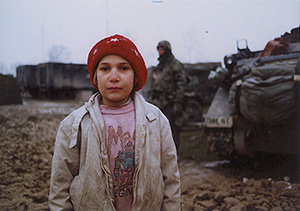
What is it with kids and G.I.s? In most places, even in areas that were controlled by the largely hostile Bosnian Serbs, children would run out to wave at a passing convoy, would surround soldiers as we got out of our vehicles, would try their few words of English and ask for "bon-bons."

In some places, often in the Bosniak or Muslim areas of the country, adults would approach to thank us for coming, for stopping the war and giving them a chance to rebuild their homes and their lives.

In some places, again usually in Srpska, we were met with sullen stares, profanities and threats.

Kids are kids are kids, and the swarms of young Bosnians always lifted our spirits. They reminded us of home, I guess, and also gave us some sense that what we were doing was worthwhile.

My feelings when speaking with the adults were more complicated. In the face of their heartfelt gratitude, their friendliness and offers of hospitality, I most often felt ... ashamed.

I remember distinctly President George H.W. Bush telling the nation, during the first Gulf War, that our involvement wasn't about oil, it was a stand against agression.

He said it repeatedly, but here's just one instance. In Oct.. 1990, at a fundraiser in Burlington Vermont, Pres. Bush said:

"You know what happened in Kuwait the other day? Two young kids, mid-teens, passing out leaflets -- Iraqi soldiers came, got their parents out and watched as they killed them. They had people on dialysis machines, and they ripped them off of the machines and sent the dialysis machines to Baghdad. And they had kids in incubators, and they were thrown out of the incubators so that Kuwait could be systematically dismantled. So, it isn't oil that we're concerned about. It is aggression. And this aggression is not going to stand..."

The incubator story, by the way, was later demonstrated not to be true. And the argument that our government's military intervention in Iraq -- then or now -- was not about oil is nonsense (see this story at Slate.com for more).

But back to Bosnia. In 1992, the United States got a new president and Bosnia was plunged into the bloodiest fighting Europe had seen since World War II. Over the next four years more than 100,000 citizens of the former Yugoslavia would die in Bosnia, and many hundreds of thousands of people were displaced under a policy called "ethnic cleansing."

The atrocities committed in that war, predominately by Bosnian Serb forces, were truly horrific. In Srebrenica, Bosnian Serbs rounded-up some 8,000 men and boys and massacred them. Captured combatants -- and sometimes civilians -- were held in concentration camps. The Serbs engaged in systematic rape of Bosnian women. Rape, as a policy of warfare.

In America, we watched the reports on CNN and listened to the BBC and clucked our tongues and shook our heads sadly. But it took three more years before we finally sent in Air Force jets and bombed the Serb artillery beseiging Sarajevo. Shortly thereafter we strong-armed the Bosnian, Serbian and Croat leaders to the peace table at Dayton.

Half a year later I was in Bosnia.

Meanwhile, Rwanda experienced a start-and-stop civil war that, in the spring of 1994, erupted into full-scale genocide. Estimates of the number of Rwandans massacred in a few short months range from 500,000 to one million.

Again, we watched it on the news, but did nothing very useful.

In neither instance, Bosnia nor Rwanda, were critical U.S. economic interests immediately at stake. And, let's be fair, oil is important ... it lubricates the entire American economy, literally and figuratively. Jobs and families' livelihoods depend on it. And maybe that's a good enough reason to go to war -- let's just be honest about why we're doing it.

I'd like to think I went to Bosnia because my country was committed to relieving suffering, to human rights, to the pledge inscribed on the wall at Dachau: "Never again."

I suspect that, in the end, our intervention in Bosnia was mostly a bid to resuscitate a flagging NATO -- a military alliance whose reason for existence had collapsed with the Berlin Wall.

At any rate, I was often proud of what we were doing there -- I thought it worth my time, worth my small sacrifice. But sometimes the gratitude of everyday Bosnians, the victims of the West's long indifference, shamed me.

Here's another view on it, written (and later performed) by a British Army officer during his tour of duty in neighboring Kosovo -- same fight, same methods, same part of the world -- a few years later.

And I'll stop it with the YouTube videos. I just figured out I can import them into the blog .... but this will be the last. For a while.

[Images courtesy DoD and Cesar G. Soriano. For an excellent and very readable overview of the U.S. Army's involvement in the Balkans, see: Bosnia-Herzegovina: The U.S. Army's Role in Peace Enforcement Operations 1995-2004]

War and peace

Yesterday I received a card from a friend, thanking me for my service to our nation. Several thoughtful cousins and uncles sent e-mails ... it's a Veteran's Day tradition in my family, to remind each other that donning a uniform still means something.

I'm not the kind of guy who wears his feelings on his sleeve, but these things bring tears to my eyes every time: a heartfelt rendition of the national anthem; a military funeral; photographs of soldiers departing for a war zone; photographs of soldiers coming home.

My service was not heroic. I have a drawer full of decorations, but they're all of the "been there, done that" and "hey, you did a pretty good job" variety. In Central America I helped clean up the mess Hurricane Mitch left behind. In Bosnia, I spent nine long months helping enforce an uneasy peace, then went back a couple of times just for the heck of it.

On five widely separated occasions, my military leave and earnings statement reflected an extra $150 for serving in a combat zone, but I never saw combat.

I've seen the aftermath of combat, to be sure. And I've witnessed the evidence of genocide. I've picked my way through minefields one careful step at a time; I've ducked at the sound of AK-47s on full automatic. But, so far as I could tell, those weapons were never aimed at me.

My experience in uniform in many ways was very different from my cousin Mikey's ... Mikey, a small, wirey Cajun and one of the sweetest guys you'd ever hope to meet, spent a large part of his tour of duty in Vietnam with a flashlight in one hand, a .45 in the other, searching out the enemy in a warren of tunnels.

I can only imagine how terrifying that must have been, and the courage it took to do that particular job.

The men and women serving in Iraq right now are in a no-shit war. Every day they go outside the wire, they can be sure that someone is going to try to blow them up or take a shot from a sniper's hide high over the street.

What I have in common with them, and with Mikey, is ... well, not much, probably. But there is this: the central feature of military service is the complete abnegation of the service member's will.

We call that order and discipline; it doesn't much matter if you'd rather not go down that tunnel. If your platoon leader says go, you go. It doesn't much matter if you'd rather not join a foot patrol through Sadr City. If you're told to saddle-up and hit the street, you go.

It doesn't matter if you're a reservist with a life and a job and a family; when the deployment order comes and you're sent off to some godforsaken corner of the world for close to a year, you go.

When a service member takes that oath and dons that uniform, he or she gives up the ability to choose. That sailor or Marine or airman or soldier doesn't have the luxury of saying "yes" to this war or operation or patrol, and "no" to that one.

No matter one's personal feelings about the rightness or wrongness, the effectiveness or usefulness, of an assigned duty, one acquiesces. It's what you do when you've signed on to become part of the terrible, swift sword of your nation's foreign policy.

To my mind, that implies a sort of social contract. Politicians, who decide when and where and how to employ this nation's armed forces, have a moral obligation to do so wisely -- to do so judiciously, for only the clearest reasons and in accord with whatever values we can all agree we share.

The civilian leadership in this country has an obligation to provide the military with the tools it needs to do its job. Those leaders also have an obligation to make sure the sacrifices our men and women in uniform make count for something ... that they're not in vain.

It's a tall order, and a heavy burden. But no heavier than a year on the ground in Iraq, or a year in the tunnels of Vietnam.

I am troubled that so few of the members of Congress -- about one quarter, today -- have themselves served in the armed forces. Even fewer of their sons and daughters go to war ... or peace.

It should be no surprise that military service in the United States peaked during the mobilization for World War II. Some 76 percent of American men today between the ages of 70 and 74 are veterans. Less than 10 percent of men under 30 are veterans.

In 1994, for the first time, the percentage of veterans in Congress dipped below the percentage of veterans in the population at large.

Historically, military service was a prerequisite for high political office in this country. It should be, still.

Vice President Dick Cheney, a former Secretary of Defense, has been quoted as saying that, during the Vietnam War, he "had other priorities."

Congressmen and senators and presidential advisers should know first-hand, should feel in their bones, what their antiseptic decisions in a hearing room or office in Washington mean to the young men and women in uniform.

Often enough, those decisions mean life and death.

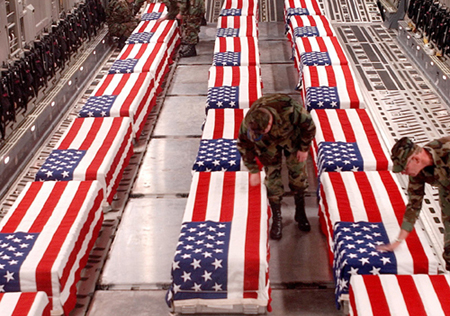
In 2004, a civilian employee at Dover Air Force Base (whence nearly all overseas casualties arrive home) sent a photo of a flag-draped coffin to a newspaper. A Freedom of Information Act request ensued, and hundreds of like photos were released to the public.

That was a mistake, according to the Pentagon, and the U.S. Senate shortly thereafter joined the Bush Administration in banning the release of such photos.

Ostensibly, the reason was to protect families' privacy. That, of course, is as absurd as it is transparent.

Sen. John McCain, a thoughtful veteran, put it this way: "These caskets that arrive at Dover are not named; we just see them," he told the New York Times. "I think we ought to know the casualties of war."

In the national discussion about whether or not our military interventions are achieving our government's policy; as we debate what that proper policy should be; as we count the enemy dead and the civilian casualties; as we tally the costs of war and peace, we should never lose sight of the human cost paid one soldier -- one mother, father, daughter, son -- at a time.

It may be that we, as a nation, agree it is a fair trade; we may count the cost acceptable. But we owe it to our troops -- the living and the dead -- to add each forfeited life, each broken family, every orphaned child into that equation.

However that math comes out, there is no doubt in mind that we owe our men and women in uniform -- those who serve today, and those who served before -- our heartfelt thanks.

Wednesday, November 01, 2006

A quiet hero

[I wrote this story – the first of many -- for Soldiers magazine in 1997. Jim Logan died, at the age of 78, two years later. Logan was the first of two Medal of Honor recipients (Richard Rocco was the other) I came to know. Both gentlemen impressed me with their humility, their … in many ways “averageness.” It kind of makes you wonder just what is the essence of extraordinary courage, and where does it come from?]

He's an ordinary man, a blue jeans and boots kind of fellow. His faded eyes, framed between a sweat-stained straw hat and a cheap cheroot, seem to regard those around him frankly, kindly. They betray perhaps just a hint of amusement at all the fuss.

He's an old man. The years have bowed his shoulders, if not his spirit, and he moves slowly now. He keeps a few head of cattle on a modest East Texas spread. He says they're eating him out of house and home.

He's a humble man. His manners are courtly in that old Texas way. When strangers approach to shake his hand and praise him in extravagant terms, he simply thanks them -- invariably adding "sir," or "ma'am."

He's a hero. The wreathed star dangling from a scrap of blue cloth around his neck makes that clear enough.

But today, half a century after fighting in the war in Europe, James M. Logan is becoming a different kind of hero at home.

Logan was a 23-year-old sergeant when he was awarded the Medal of Honor for "conspicuous gallantry and intrepidity in action at the risk of his life above and beyond the call of duty."

It's typical of the man that he says he didn't do anything all that special.

"The boats dumped us out there, and we had to get off the beach and find a place to rest," he said while visiting Texas Army National Guard troops during annual training at Fort Hood, Texas. "I heard later that the barges came back to the beach to take us off, but no one told me about it at the time."

The beach was near Salerno, Italy. When the 36th Infantry Division from Texas spearheaded the Allied invasion of Italy on Sept. 9, 1943, Logan was one of the first off the landing craft. His company advanced 800 yards before being pinned down by
German soldiers entrenched behind a rock wall.

Someone had to open the way for the Americans to get off the beach, so Logan took the initiative. According to his Medal of Honor citation:

"Voluntarily exposing himself to the fire of a machine gun located along the rock wall, which sprayed the ground so close to him that he was splattered with dirt and rock splinters from the impact of the bullets, Sgt. Logan killed the first three Germans as they came through a gap in the wall. He then attacked the machine gun."

A withering stream of fire followed his advance as he dashed across the 200 yards of exposed terrain. Reaching the wall, he crawled along its base, within easy reach of the enemy crouched along the opposite side, until he reached the machine gun. Jumping up, he shot the two gunners, and hurdled the wall.

Then he seized the gun, swung it around and opened fire, killing several more of the enemy and capturing two others.

Later the same morning, Logan again left his company when a sniper began firing at the Americans from a house some 150 yards away. According to the citation, he ran a gauntlet of fire to reach the house, shot the lock off the door, kicked it in and shot the sniper.

But he was no Rambo. He didn't enjoy war; the misery, the killing, the terror. He turned down a battlefield commission, afraid that if he accepted, the Army would keep him in Europe longer.

Friends say that now he regrets that decision. They say he feels bad about coming home before the war ended. As if, contrary to the abundant evidence, he didn't do his part.

When Logan returned to Texas in 1944, he was subjected to a lot of fanfare and hoopla. Parades, dinners and an immensely successful statewide war bonds drive kept him in the limelight for a while.

When it was all over, he went to work in the oil fields. For more than four decades he lived quietly near the small East Texas town of Kilgore, working hard and raising a family.

But he wasn't forgotten.

Sgt 1st Class David L. Squires said he first read about Logan's exploits back when he was a brand-new private. Much later, after becoming the full-time readiness NCO for the Texas Army National Guard's Company D, 3rd Battalion, 144th Inf., at Kilgore, he realized the quiet hero lived just a few miles away.

"A lot of guys in Kilgore didn't even know he had the medal," Squires said. "I started to get to know him, and realized what a great guy he is. And there are so few Medal of Honor winners left … I just wanted to do something to honor him."

Squires saw an opportunity to do just that when the National Guard decided to build an addition to the Kilgore armory. When the addition was dedicated on May 17, it was named for Technical Sgt. James M. Logan.

Then on Memorial Day, the 76-year-old Logan became the first person in history to receive the Texas Legislative Medal of Honor. At a Texas Rangers baseball game in late May, the old sergeant was introduced to a packed stadium and received a standing ovation. Capt. Dennis Spillman, who keeps tabs on such things, said recruiting figures in the battalion immediately went up when local residents learned of Logan's tie to the unit.

Now Logan has taken to visiting area schools to talk about patriotism, service and respect for the flag.

"He's really starting to enjoy talking to the kids; he's really coming to life," said Richard Fuhrman, a retired combat veteran of the Air Force and Logan's friend and neighbor.

"He does so much good for the children. They just love him."

Others agree.

"At first, as a group, they were a little bit in awe of him," said Leslie Listenbee, a second-grade teacher at Kilgore's Chandler Elementary School. "The day after his visit, when we stood at attention to recite the Pledge of Allegiance, I told the kids: 'You know, Sgt. Logan is one of the reasons we do this.' They all stood a little straighter after that."

Listenbee said Logan's visit has given her 7- and 8-year-olds a lot to think about. "One of my pupils told his mother on the way home from school: 'Mom, a lot of people think stars like Michael Jordan are heroes, but Sgt. Logan is really a hero.'"

According to Listenbee, Logan cried when his friend Fuhrman told the children how he won the Medal of Honor. Other people who know him say he often does that when the story is recited.

"He's so humble. That really made an impression on the kids, and they reacted so well," said Listenbee. "The girls went up to him and held his hand. It was a wonderful experience; I really hope he can come back next year."

"I've tried real hard not to remember the war," Logan said quietly. "But here lately, a lot of people seem to want to remind me about it."

He admitted that the memories upset him. But he also said he wants to visit every school that invites him to speak.

No one would disagree that it's hard. It's hard for an old man to relive brutal events that happened on another continent 54 years ago. No doubt it's also difficult at times to bear the blunt and energetic adulation of children.

But then, no one who knows him expects Jim Logan to shrink from the challenge.