Showing posts with label kayaking. Show all posts

Sunday, December 09, 2007

Bless these men

Saturday I had the rare privilege of spending a couple of hours on the water with eight wounded warriors at Blanco State Park. The soldiers -- all undergoing medical treatment and various therapies at Brooke Army Medical Center in San Antonio -- were there as part of a "Heroes on the Water" outing.

Heroes on the Water is the first project undertaken by Kayak Anglers Society of America, founded by my friends Brad, Ken and Jim. This was their fourth trip.

Some of the guys told me about their "duty day" at BAMC: morning formation, then various appointments all day long, then back to a spare barracks room. One of the guys admitted that, a lot of times, it's easier to just stay locked-up in that room on a Saturday than attempting to get out and deal with the world.

Maj. Cody Roberson, a Medical Services Corps officer who founded ArmyBassAnglers.com, does a good job of protecting the troops from the raw curiosity of sponsors and spectators alike. Cody knows first-hand some of what they went through in Southwest Asia: he commanded a medical company there early in the war.

Two of the soldiers were amputees; some were injured in blasts, others were burn victims. Some had no immediately obvious injuries; following Cody's lead, I didn't ask.

There's no doubt in my mind, though, that every one of them is in some way broken by his experience; as Jon Dee Graham sings, "not beautifully broken, just broken ... that's all."

The Heroes on the Water program gives these troops an opportunity to get out, almost on their own, for a few hours. Sure, there are therapeutic aspects to kayak fishing -- fine motor skills, balance, strength; it's the sort of thing that is good for anyone to practice, but especially if you're, say, learning to use prosthetic thumbs. Or new legs.

But maybe the best thing about these excursions is the opportunity for the soldiers to simply relax -- away from case managers and appointments and the same ol' same ol' of their barracks rooms. To watch a wild turkey fly across the river, or feel the tug of a fish at the end of a line.

I've always had a soft spot in my heart for soldiers. As a kid, because I looked-up to them and admired them. As a young adult, because I was one. Now, because I remember.

I remember the difference it made to me when someone actually showed they appreciated my sacrifices.

I wonder at the kind of courage and strength it takes to even attempt to become truly whole again after the sorts of injuries -- and experiences -- these men have suffered.

Awe is not too strong a word for what I feel for these "warriors in transition," now that I have met a few of them.

Cabela's donated rods and reels for the outing, and the Blanco American Legion Post provided a late lunch. Blanco State Park staff opened their arms to the group and waived entry fees. Brad and Colleen Harvey of Heart of Texas Kayaks brought the boats. Such generosity is always humbling.

But a lot of it still comes out of KASA's -- Brad's, Cody's, Jim's and Ken's -- pockets. You can help sponsor the next Heroes on the Water trip (there's a waiting list 20 soldiers deep now) by donating online at http://www.kayakanglerssa.org/. Or, if you or someone you know would like to donate products or services -- fishing stuff, ice chests, transportation, PFDs, fishing garb or hats -- send Brad an email.

KASA is a non-profit corporation (501(c)(3) status is on the way), and donations are tax-deductible.

Tuesday, November 13, 2007

Nuts for the Nueces

Driving south from San Antonio on Interstate Highway 37, the first hint of the city of Corpus Christi is the gleaming profusion of refineries off in the distance: scaffolding and gas flares, storage tanks and distillation towers. At night, the lights look like a cityscape in their own right.

The refineries exist because of the Port of Corpus Christi -- the nation's sixth-busiest -- and the port exists because of the Nueces River.

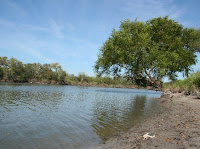
Shortly after the refineries come into view, the interstate crosses the river. Here it is a slow, silt-laden stream crawling between muddy banks choked with mesquite, willow and scrubby oaks. Just downstream, the river meanders into spartina marsh before emptying into the shallow, reef-strewn reaches of Nueces Bay.

That's the Nueces I grew up with.
It is a distinctly different river some 300 miles upstream at the western edge of the Edwards Plateau. Uvalde, about 50 miles from the river's headwaters and a good four-hour drive from Corpus, is the only other town on the entire river with a population above three digits, and it boasts only around 17,000 souls.

Last weekend, with four friends, I set out to explore that difference, and the river that has long been calling to me.

Marc McCord, writing for SouthwestPaddler.com, reports that: "The spring-fed, crystal clear water flows through the limestone bluffs of the Edwards Plateau, and is one of the most scenic river trips in Texas."

McCord also reports that some 45 miles of the upper Nueces, from north of Barksdale to near Uvalde, are navigable nearly year-round.

Not so, said Marilyn Stoner. Marilyn and her husband Tom own Clear Creek Outfitters in Camp Wood. From the paddling shop-and-antique store on the main drag, they rent kayaks, provide shuttles and counsel kayakers on current river flows and conditions. The advice and help with route planning is free to all comers.

"There is a lot of outdated information on the Internet," Marilyn told me when we stopped in Friday. "I don't recognize some of the things I read about the Nueces. This river changes all the time."

Marilyn warned us that the river is shallow in many places and we'd probably end up dragging the boats part of the way.

"There are rocks in some of those rapids that will eat boats," she said.
Of course, the same is true of most Hill Country streams. The classic pool-and-drop configuration of these spring-fed rivers, with the hard, limestone bedrock of the Edwards Plateau, mandate carrying a strap or line with which to pull boats and decent footwear for the portions the paddler will be forced to walk in ankle-deep water.

On the Nueces, even more than some other Hill Country streams, rises can come quickly. The river's watershed is huge -- it drains something like 17,000 square miles -- and a downpour out of sight and sound beyond a ridgeline can translate into a sudden wall of water under bright sun and blue skies somewhere else minutes or hours later.

To my surprise, I found the portions of the Nueces we paddled -- at what Marilyn and Tom said is average or just below-average flows -- to be more easily navigated than most Hill Country streams farther east.

On one six-mile reach I was forced out of my boat exactly once, and then only because I chose the wrong channel at the head of a riffle.

There are few legal camping spots along the river bed, and an even smaller number of comfortable ones. But with frequent county road crossings between Camp Wood and Uvalde, daytrips with overnights in one of several private campgrounds in the area is a good strategy.

We chose Big Oak campground just south of Camp Wood, where tent camping sites include water, electricity, fire rings and grills.

A trip like this isn't all about the paddling, after all, or fishing, for that matter.

It's also about leaving workaday concerns behind. It's about the joy of watching a belted kingfisher hover above a riffle, dive and emerge with a minnow in its beak. It's about the play of light and water and limestone, and a flock of wild turkeys coming down to drink.

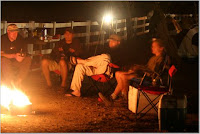
It's about good friends and good food and the lies guys tell around the campfire.

Vince (an old college buddy of like mind who I'm just now really getting to know) brought venison fajita meat -- and his Big Bend staple, Easy Cheese (I'm now a convert); Ken, my regular coastal paddling partner, provided a flask of apfelkorn. Danny -- my fishing partner of more than decade -- and Schu, another Houston friend, kept busy passing icey cans of Pearl Light around the fire.
After a full day of paddling -- and with well over 100 fish caught between us -- Saturday was an early night. After coffee and campfire eggs and sausage in the morning, we decided to break camp and enjoy the scenery on the way home rather than attempt the three-hour paddle we had planned for farther downstream.

For Vince and me, that meant heading 20-plus miles cross-country from Barksdale on an unpaved county road that wound through large ranches along the canyon carved by Bullhead Creek. That road connected to Ranch Road 336, which plunges south to Leakey.

From Leakey, it was left on my old friend FM 337 through Vanderpool and down to Medina.

Between Leakey and Vanderpool, Vince and I pulled off at a picnic area high atop a ridge to stretch our legs and grab a quick bite to eat. As we carved chunks of venison sausage onto saltines liberally spread with Easy Cheese, we heard a voice: "Good job! You're doing great! Just a little farther now ...."

We turned to see a young boy -- probably only 9 or 10 -- coast to a stop on his bicycle. Behind him came a man on a triple-seater, two younger children behind him.
I was amazed they had all pedaled up the hill we would soon coast down in my truck. Iwas even more amazed when the man told me they had come all the way from Medina, and their destination that evening was Camp Wood.

A Team Cyclone support trailer pulled in a few minutes later, so I guess they probably knew what they were doing. But still. Wow.

Closer to home, a quick stop at a top-secret fossil hunting site yielded the most numerous and perfect clam casts I have yet seen, as well as a handful of fossilized sea urchins. Family obligations kept us from lingering long, but we plan to take the kids back Saturday.

It's a fine coincidence that Sunday is one of two "Fossil ID Days" UT hosts each year. Look for a report on that expedition here after the weekend.

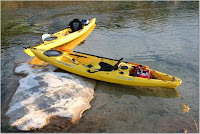
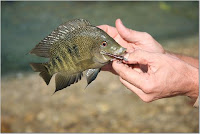
[The Nueces at LaBonte Park, alongside IH-37 just north of Corpus Christi. Note the dead crab in the foreground; still life with boats on the Nueces River near Big Oak River Camp; this view of Ken's right foot gives a pretty good idea of both the water depth and quality in the upper Nueces (photo courtesy KendalLarsonPhotography.com); Schu and Danny negotiate a snag in a tight bend on the upper Nueces below Camp Wood; A nice Rio Grande perch, the only cichlid native to Texas; Danny, Ken and Vince show-off a largemouth bass triple-header; Vince admires a nice Nueces River Guadalupe bass; Ken goes for broke with the Easy Cheese; sitting around the campfire; You never know what you might see on the roads through the Hill Country. Here, two camels kiss; Five tired but happy bikers at the top of the ridge between Vanderpool and Leakey ; even if you don't paddle, or fish, the trip to Camp Wood is worth it for the amazing scenery. We figure the more warning signs, the better the drive (photo courtesy Vince Terracina, TAG Marketing).]

Friday, August 10, 2007

Big water, big fun

Paddling, lately, has been work. I'm either on the coast, paddling north to complete the coastwise journey (the Cabela's Kayak Safari) or paddling a river or stream somewhere for the Falcon book.

This week I went paddling for fun. Oh, okay ... it was for fun and profit; there will be a magazine article too.

Ken and Dean drove down from LaPorte and Aransas Pass respectively. TSJ Senior Editor Steve Lightfoot and I carpooled from Austin.

We all met at Getaway Adventures Lodge, my Port Mansfield home-away-from-home, where we joined Temple Fork Outfitter's Jim Shulin and Capt. Brandon Shuler for an offshore adventure.

So what can you look forward to in Texas Sporting Journal? Hmm ... well, we caught some fish. We got beat up and beat down by rougher-than-predicted conditions. We participated in the open-water barter economy. We all marvelled at the surreal, serenely cerulean sea.

There was some tomfoolery, too. It's tough to schedule a fishing trip with Dean and Ken and not get some of that. Fortunately, Jim and Brandon fit right in -- held their own quite well, in fact. So did Steve, which was no big surprise.

Kinda scary, considering these guys are all real, live professionals.

The trip confirmed something I've known for a long while; just getting out there is the best thing about these adventures.

It doesn't matter whether the trip lasts a day or two or a week. And whether and what we catch comes in a distant third to the opportunity to immerse oneself in wild and beautiful nature and the camaraderie of good friends.

Thursday, June 28, 2007

Odds and ends

Life is busy, busy, busy. Big changes in the offing on the homefront, seemingly ceaseless rain across the middle of the state (and accompanying busy-ness at work), lots of writing deadlines; I'd sure like to slow things down a bit.

Contrary to that deep-seated desire, I've been chatting back and forth with the editor of RoadTrip America about some brief web pieces. RTA pays comparatively well, I'll be roadtripping anyway, so ... why not?

One reason why not, or that gave me pause anyhow, is that web publishing demands some level of exclusivity; RTA likes all electronic rights in perpetuity. We've negotiated 12 months on text, 6 months on photos. So while I'd really like to write here about a fun road trip out to Menard, the 1750s Spanish acequia there and an adventure at the London crossing of the Llano River ... I can't. But look for it at RTA next month.

The good news that comes with all the rain across the state this spring is that the aquifers are full, the rivers and streams are full, and it should be a good paddling summer. It's a big change after a couple of drought years; in fact, right now there's too much water in some of the rivers I plan on including in the Falcon book.

My editors liked the sample material I sent, by the way, so I'm feeling more confident about being on the right track with that.

On the coastal paddling front, the long July 4 weekend will see me stroking north from Padre Island National Seashore to Rockport, my hometown. Tam's going to give coastal paddling a try, says if she doesn't like it she'll catch some rays on the beach and pick me up at the take-out.

The next weekend I'll paddle on up to Seadrift. Like much of the middle and upper coast, here redfish, trout and flounder will be on the fishing menu. But around Corpus Christi and Port Aransas, I'll also get a few shots at tarpon and snook and that's a pleasant prospect.

Patrick's been having a ball with his cousin Chris and their Grammi and Papa. Longview -- berry picking and the Texas State Railroad; Austin -- Children's Museum and gellato and some Daddy time; Ingleside -- beach today, fishing with Uncle John tomorrow and some more Daddy time this weekend ... it all reminds me of the kind of summers I had as a kid.

Did an in-studio interview about boating safety with Bryan Beck at KGSR-FM this morning, and was reminded that Austin really is a great music town. Stumbled across "My Baby Now," by Bruce Robison, earlier in the week. Good stuff, and ... well, I find it calming.

And while I'm making recommendations, check out Love Warps the Mind a Little by John Dufresne. I'm reading it again, a second run-through within 12 months, and it's lovely in about a dozen different ways.

Sunday, June 03, 2007

An update

I've been asked, urged, begged -- okay, not really begged -- to update this blog.

Some folks want to know how the last leg of the Kayak Safari was. Not much fun, but more in a moment. Some people want to know if I'm still alive. Yep. At least one person just wants to be amused. No promises there ....

This weekend is a busy writing weekend; I'm wrapping up my contractually required "sample" chapter for the FalconGuides book. It's actually quite a good exercise as it reminds me of all the things I need to pay attention to when I'm out on the water.

Here's one: Don't Leave the GPS on the Tailgate of the Truck.

So. The last leg of the coastwise trip was tough. Day one: 17 miles in a quartering gale, water the color of chocolate milk. Day two: 22 miles up the ditch. An overnight thunderstorm nearly blew us away. Day three: North winds. Day four: North winds.

I think we ended up catching maybe 10 fish between us -- nothing really noteworthy. Saw some birds. Built a couple of nice campfires. And we were really happy to step ashore at Bird Island Basin after four days and 70 miles on the water.

It was such a challenging leg of the trip -- such a grind -- that I joked more than once that it would be the Haiku feature story.

Here are a couple from the trip:

Waves roll, cockpit fills.
Wind howls, pushes petulant;
Riding chocolate milk.

Coyote watches:
Ears pricked, eyes keen, nose scenting;
What creatures, these boats?

Sunlight burns water
Bright; stroking, stroking onward.
Miles to go ‘til night.

Rain like bullets splat.
Tent walls tremble, folding flat ...
Sleep, at last, ‘til dawn.

Liquid sky below
Ripples, rolls, clears, surprises:
Raccon tracks in mud.

Green water, red fish
Grubbing mud, tail tasting air;
I cast ... not hungry?

Sand: spilling, slipping,
Racing to the water’s edge,
In cool repose rests.

Journey ends, paddle rests;
Strangers offer cold beer:
A good day at last.

That's not to say, of course, that the article won't be worth reading. One of the things a near-fishless 70-mile stretch of S. Texas did was give me the opportunity to talk more about the fascinating history of the Wild Horse Desert.

The next leg of the kayak safari brings me to my home waters, that stretch of bay and beach that I've roamed since I was a child. I'm looking forward to it.

Sunday, May 06, 2007

Here we go (again)

Leg two of the Texas Kayak Safari starts Tuesday.

Tomorrow I'm driving to Rockport, picking up buddy Kendal, and then on down to Port Mansfield. We'll launch where we took the boats out of the water after our paddle from South Padre Island: Getaway Adventures Lodge.

From there, it's about 90 miles to Snoopy's at the island foot of the JFK Causeway in Corpus Christi.

Ninety miles and no towns. King Ranch to the left, South Padre Island National Seashore to the right. Wind at our backs, we hope.

We'll need to average about 15 miles a day to arrive by Sunday afternoon. The first day -- Tuesday -- will be the longest, a 17-mile paddle to a spoil island just south of the Landcut.
Along the way we'll fish for reds and trout and flounder and enjoy the sights of the Wild Horse Desert.

Once we hit Corpus Christi, I'll have completed about one-third of the coastal journey. From Corpus north, the towns are closer together and there are a lot more of them. We'll start doing shorter legs there -- weekends, mostly.

See y'all in about a week.

Monday, April 23, 2007

The Perfect Weekend

In his gripping, true, tale, The Perfect Storm, Sebastian Junger describes a combination of meteorological phenomena that came together in a way so rare as to create the type of storm seen only once a century, if that.

Thankfully, my perfect weekends lately come more frequently -- if not entirely routinely -- but they also rely on a combination of disparate elements that, together, create something rare.

And unlike the storm that swallowed the Andrea Gail, my perfect weekends are things of great joy. Take this past weekend, for instance.

It included an easy Friday-night dinner date with the adult I most like to spend time with. It was the perfect conclusion to a long work week.

Saturday, we paddled eight miles of the upper Guadalupe River with friends -- work, because it will be one of the stream segments profiled in Paddling Texas -- but the kind of work I'll take any old day. It's one of those perfect second jobs you hear about.

Saturday night it was off to Kerrville for a house concert at the home of cousins Paula and Marty. Bonnie Bishop put on a great show and I'm completely sold on house concerts as opportunities to hear live music. People actually listen!

Plus, Aunt Kathy and Uncle Bob were there, as were cousins Ray and Jordan ... good beer flowed freely and the food was great. Perfect.

Sunday, after a leisurely breakfast featuring the time-honored family recipe, "Snappy Eggs," Tam and I headed out for a Sunday drive.

Initially, I just wanted to see the Hill Country folding in on itself in the mist along the edges of Texas 16 west of Kerrville. From the top of the hill down to Kinky Friendman's Echo Hill Ranch is my favorite part of my favorite drive in the state. And it was beautiful. Perfect, even.

Since we were already there, we stopped at the first Hwy. 16 crossing of the crystal-clear Medina River.

I caught a beautiful 15-inch bass and a couple of sunnies, and Tamara caught two smallmouth bass -- her first. Honestly, we could have stopped right there and it would have been a perfect day.

But we kept going.

At Lost Maples State Natural Area, we hiked through a light rain up to the ponds on Can Creek and fished a little more.

On the way up, we spied a white-lined sphinx moth -- the so-called "hummingbird" moth -- sipping nectar from purple Prairie verbena along the edge of the trail.

Uncle Bob, not a dozen hours before, had described this intriguing little insect (he had seen it in Colorado) as we watched the hummingbirds at the feeders on Paula and Marty's porch. Perfect timing.

On the way back down, we watched for a while an unafraid Scrub jay go about its business, and then saw the jewel-like Indigo bunting on a feeder near the parking lot.

One bird I hadn't seen before, and one I hadn't seen in a very long time. Perfect.

Later, unwinding after the long road trip, I heard an Eastern screech owl trilling its "A" song over Bull Creek. What a lovely night sound, especially with a chorus of frogs in accompaniment. It was kind of the perfect end to a perfect weekend.

Sweet, live water with kayaks above and fish below; glimpses of nature's glory, primarily in blue -- blossoms and feathers; music, soulful and fresh and not 15 feet in front of me; catching up with family -- people I've known, and liked, literally all my life; the company of someone I've met only recently, a beautiful woman I'm proud to call my friend ... these are some of the things that, together, can make for a perfect weekend.

[About the photos: Happy paddlers on the upper Guadalupe River; me, with a Guadalupe bass-Smallmouth bass hybrid; Tamara in front of a spring falling into the Guadalupe; a white-lined sphinx moth sipping nectar from Prairie verbena; raindrops caught in a spider web; Blue-eyed grass, a member of the iris family.]

Monday, April 09, 2007

Where we are

Late last week I took a cyber-stroll by this site and realized it had been nearly a month since I'd posted anything new.

Kinda made me feel guilty.

So, below, you'll find a recap (with photos) of the most recent leg of the Texas Kayak Safari. Most of that information also lives at http://www.texassportingjournal.com/, so if you bopped on over there last month you probably already have read it.

There's more, and a different version, coming out in the magazine in the May/June issue. Pick it up at Barnes & Noble or your local news stand, or -- better -- go to the magazine Web site and sign-up for a subscription.

Weather forced a postponement of the Easter weekend paddling leg from Port Mansfield to Yarborough Pass; we had sleet and snow in Central Texas, and gusty north winds and temps in the 40s and 50s on the coast. It was a good weekend to do other things.

Hopefully that will be the last big blast of cold air until sometime around Thanksgiving. Bay waters are warming, spanish mackerel and kingfish already are showing up on the middle coast and with big bait balls moving along the shore the tarpon shouldn't be far behind.

Speaking of tarpon, I recently read an unpublished manuscript by Hart Stillwell. Stillwell was a legendary Texas writer who penned Hunting and Fishing in Texas and Hunting and Fishing in Mexico along with a novel and more. Back in the day, you could find his articles in True and Cosmopolitan (I'm not making this up) as well as Field & Stream and Outdoor Life.

This book, unearthed in an attic box at Texas State University's Alkerk Library by my colleague Steve Lightfoot, was to be titled Glory of the Silver King.

It's a fascinating look at changing conservation ethics and -- especially interesting to me -- the tarpon and snook fishery in South Texas and northern Mexico from the 1930s through the 1960s.

Flotsom and jetsam

From Wikipedia: Traditionally, flotsam and jetsam are words that describe goods of potential value that have been thrown into the ocean. There is a technical difference between the two: jetsam has been voluntarily cast into the sea (jettisoned) by the crew of a ship, usually in order to lighten it in an emergency; while flotsam describes goods that are floating on the water without having been thrown in deliberately, often after a shipwreck.

Lots of folks have questions about various aspects of the TSJ kayak journey, and I thought it might be helpful to provide answers here, and to wrap up some loose ends … bits and pieces of information that have been bobbing about in my brain for the past couple of months.

One question – or maybe it’s an observation, and it often goes unspoken – is whether this is truly an epic journey.

In my view, the answer is both yes and no. More than 380 miles from Mexico to Louisiana under paddle power … well, it’s a long way. Many segments, such as the one just completed, will include multiple days of paddling and camping miles from civilization and supported only by what we can carry in our boats.

But I’m not the first to try something like this. Swedish mountaineer and adventurer Renata Chlumska took just 32 days to kayak from Brownsville to New Orleans as part of her “Around America Adventure,” which began in July 2005.

Gene and Rachel Gore of South Padre Island paddled 404 miles of Texas coastline on the outside in May 2004. They did it in just 19 days. On surfboards. Rachel survived a mako shark attack on her board north of Port Mansfield.

In February 2003, Arthur Hebert and Larry Koenig of Louisiana set out to circumnavigate the Gulf of Mexico. From Grand Isle, Louisiana, they actually paddled as far as Isla Mujeres on Mexico’s Yucatan Peninsula in 139 days.

Chlumska, Hebert and Koenig all did their paddling in traditional, decked touring kayaks – the kind many folks suggested I use if I want to cover long distances quickly and comfortably.

I admire the beauty, speed and load-carrying capacity of sea kayaks, but they are very few paddlers’ first choice for fishing platforms.

My thought? Do this trip in the kinds of boats most of the nearly 8,000 members of the Texas Kayak Fisherman community use. Do it in a boat someone can go buy for $800 or less, and nearly anyone can paddle.

But, even this has been done, and done big. Just not in Texas. In 2005, “Kayak Kevin” Whitley completed a solo, 1,800 mile kayak fishing odyssey from Big Lagoon State Park in Pensacola, Fla. to his home in Norfolk, Va.

All that said, Dean made an observation as we were sitting around the campfire one night between South Padre Island and Port Mansfield: “Not many people – even people a lot younger than us – do this kind of thing anymore,” he said. “This really is an adventure.”

Another feature of this trip that makes it different – and it’s a decision we just made – is to paddle nearly all of our miles on the “inside,” behind the barrier islands. It’s almost counter-intuitive, but the most remote waters on the Texas coast are in the bays. It also removes from the equation the one variable that’s difficult to overcome: big surf.

Finally – and this has come up a lot – while it would be cool to knock-out the entire trip in 30+ paddling days straight-through, I have a day job. So do my regular paddling partners. So we’re making the trip in segments or legs, mostly long weekends.

What’s the point of all this?

Well, we’re paddling the entire Texas coast for a couple of reasons. The first, and the one that keeps me going, is that it’s just plain fun. I enjoy kayaking. I enjoy fishing. I have a longstanding love affair going with Texas’ inshore waters, and I truly believe there is no better way to experience that environment than in a kayak.

As we began planning this trip, it occurred to us that a lot of folks are going to the same old launch points and paddling the same old water … week after week, year after year. Granted, some of those spots – Lighthouse Lakes comes to mind – are primo paddling areas by anyone’s definition. But they represent just a fraction of the more than 3,000 miles of tidewater coastline in Texas.

We figured that, by paddling the entire coast and writing about it, perhaps we could inspire other kayakers and anglers to sample some of the more remote waters the Lone Star State has to offer.

Finally – and this has been an important consideration from the beginning – I wanted to get a sea-level look at the entire coast at the beginning of the 21st Century. Because changes, they’re a’comin’.

As I’ve hinted before, we can be hard on our land and our water here in Texas. The Gulf coast and in particular our bays and estuaries face some truly vexing challenges in the coming years. Among these are booming development, freshwater inflow from increasingly taxed rivers and streams, energy development and point pollution from industry.

The news isn’t all bad, and the state of our red drum fishery is indicative of that. It’s better now than it has been anytime in the past 30 years.

Yeah, but why you?

Well, I thought of it and then presented the idea to a publication that was just crazy enough to take a shot at supporting the notion.

To be honest, I really don’t have any special qualifications.

I’ve been mucking about in boats and chasing fish since I was in grade school. I’m a second-generation native of Rockport, on the middle Texas coast. I’ve taught windsurfing and sailing, and I’m a state-certified Boater Education and Angler Education instructor.

I’ve been paddling for about the last seven years, much of that time on the Texas Gulf Coast.

But, part of the beauty of this project is that just about anyone in decent physical condition and with moderate paddling skills could do it. That’s part of what I hope to demonstrate.

You could do this. Probably.

What about safety?

Safety is something we are taking very seriously as we paddle up the coast. In addition to carefully planning our pack list to include first aid supplies (and someone who knows how to use them), we also carry GPS units, VHF radios and cell phones.

Prior to each segment, we file a detailed float plan with the magazine headquarters, and provide approximate check-in and landfall times.

We have a powerboat on standby during each segment, too … someone we can call in the event of an emergency, or who will come find us if we go missing.

Even in the Lower Laguna Madre, with average water depths of 3 feet, we habitually wore our personal flotation devices, or PFDs. It’s a good habit to get into, and habits are born of repetition.

Where does the equipment come from?

The only way I can afford to make this journey is with help from sponsors. In some cases, the sponsors also advertise in Texas Sporting Journal. In others, they simply provide products for us to use.

Hobie was first to sign on, and has provided two Hobie Mirage Adventure kayaks for the trip. Ocean Kayak was an early sponsor with the Ocean Kayak Prowler 15 models, and my friend Scott Null at Wilderness Systems arranged for delivery of two Wilderness Systems Tarpon 160i boats.

An off-route, offshore segment will feature the super-stable X-Factor and Mini-X kayaks from Malibu.

As we discussed which models would be suitable for this trip, my focus was on speed (which usually translates into hull length) and load-carrying capacity. That narrows a field of dozens of great sit-on-top plastic boats to just a handful of great, long boats. I think we have the right models.

Paddles were donated by Bending Branches, and the fiberglass Slice and Slice Angler models I’m using are good all-around rec paddles with enough power to brace in big surf and enough flex to be comfortable for hours at a time.

NRS provided dry bags, including their Expedition DriDuffel, a commodious and tough bag that turns a Tarpon tankwell into a secure and watertight storage area.

Temple Fork Outfitters, a fantastic (and not-so-little, anymore) Texas fly rod manufacturer, donated fly rods and reels, and my old friends at Pflueger-Shakespeare sent me some more of the reels I actually buy (Pflueger Presidents and Supremes) to match with All-Star rods.

If they’ll handle 40-pound tarpon and 35-inch snook, both on 12-pound test line, you’re not going to have to worry about how they perform on redfish and trout.

Garmin sent me a GPSMap76Csx handheld GPS unit, along with BlueChart cartography for the Texas coast. It has performed flawlessly.

Cabela’s provided inflatable PFDs and camping gear, including a Deluxe XPG tent and XPG Backpacker sleeping bags. GSI Outdoors provided our camp pots and pans, as well as a hand-powered coffee grinder and French press coffee pot. My footwear was provided by Bite.

In seeking and accepting sponsorship offers, I looked for products I already know and like, or products I believe have a high likelihood of being useful, durable and successful in the field. If it doesn’t work, I’ll let the sponsor know why, and you won’t be reading about it here.

But the fact is, all of the stuff we’re using does work, most of it very well. That’s why we’re using it.

What other fish are you going after?

Ah … the fish. Fishing is a big part of this trip, and we were ambitious when we drew-up the list of species we’re targeting. Happily, we can scratch one of the most elusive – snook – off the list already. My 35-inch linesider from March 2 in Brownsville tied the state catch and release record for rod and reel.

It also was a hell of a lot of fun.

Other fish we’ve already caught include jack crevalle, red drum, ladyfish and spotted seatrout. We’ll be looking for bigger reds and speckled trout as we move north.

Also on the list are: Southern flounder, Spanish mackerel, King mackerel, Blackfin tuna, Bull shark, Blacktip shark, Atlantic bonita, Cobia (ling), Tripletail and Tarpon.

Yeah, you read right; Blackfin tuna. Stay tuned.

And I’m sure we’ll pick up some incidentals; in fact, I wouldn’t be surprised if we end up with something in the neighborhood of 20 species before all is said and done.

We’ll be pursuing all of these species primarily with artificial lures – soft plastic jerkbaits, topwater plugs and flies. Not because we frown on fishing with bait, but because it’s our preferred method of fishing and it relieves us of the task of catching and keeping bait alive, or carrying dead bait where we might not have ice.

I use Norton Sand Eels with great success. All of the fish I caught during the first segment – snook, jack crevalle, speckled trout, redfish and ladyfish – came on the “salty chicken” (pink and green) 6-inch sand eel. I switched to flies for a few of the ladyfish, just to exercise my casting arm.

After fishing with Capt. Danno Wise and Lonnie Stanley of Stanley Lures late last week, I’ll also be trying out some of Lonnie’s wedgetails and swimming jigs. They look great in the water and I’m betting they’ll catch fish.

Can I come?

Maybe. I’m happy to paddle with cheerful, irreverent, observant folks who have something to offer the expedition.

You should be an able swimmer and capable of paddling 15 miles per day in a fully loaded kayak. You have to be able to unhook your own fish. It helps if you know how to use a camera.

You’ll have to keep up, or have your own evacuation plan if you can’t, and you’ll be responsible for your own boat, paddle, PFD and most of your groceries. We can help with shuttle service.

If you’re truly interested, drop me an e-mail at AReed at TexasSportingJournal.com.

Saturday, April 07, 2007

Landfall

Wednesday dawned calm and bright, but the first stirrings of that friendly – and until late August, likely persistent – southeasterly were not far away.

Before Dean Thomas and I had left the shore, Ken Larson landed his first trout at the edge of the Intracoastal, just off our campsite. We landed two more before paddling in earnest up the western shoreline of the bay.
Today’s agenda: cover about a dozen miles and reach Capt. Bruce and Shirley Shuler’s Getaway Adventures Lodge in time for happy hour. With an early start and a tailwind, that still left time for fishing.

I got just one more shot, a late morning redfish foraging in the turtle grass on a shallow flat. I spotted the fish about 10 feet off my port bow and stopped paddling as I reached for my rod.

Momentum carried me past the redfish, and I turned to cast over my shoulder. The soft plastic lure landed just beyond the grass bed, and I saw a swirl as the redfish lunged. Then my line came tight. A 26-inch redfish is entirely capable of towing a 16-foot kayak.

Kinda makes you think, doesn’t it?

After Dean snapped a few quick shots, we released the fish and continued north at a steady pace. Before long, the Port Mansfield water tower crept into view. We stopped once to stretch our legs, then continued on in what had become choppy bay waters.

Just after 3 p.m., we turned left around the levee and paddled into the protected waters of the harbor. The lodge was clearly visible ahead of us on the right, but so was the Port Mansfield Marina, where I suspected we might be able to grab a cold beer or two.

We tied-up in front of the gas pumps on the seawall and were greeted by friends from the TexasKayakFisherman message board. They had been following the pre-trip discussions, and knew we had launched from South Padre Island Monday.

I was abashed to see that they were genuinely surprised we’d made it.

At Getaway Adventures Lodge, Bruce helped steady the boats as we climbed out and relished the notion of cold showers and soft beds. After dragging the boats across the rip-rap and onto the lawn, we sprayed-down rods and reels and sat down to swap stories.

Capt. Brandon Shuler, Bruce’s son and a fine fishing guide in his own right, swung by to say hello. “Man … my dog smells better than you guys,” he quipped. “Looks better, too.”

Landfall, I know from my sailing days, always brings with it a sense of accomplishment. To climb into a boat – several very small boats, in this case – and arrive some days later at a destination over the horizon is one of life’s great joys.

In our shakedown leg of the TSJ Kayak Safari, we covered exactly 45 miles of water, all under paddle power. We put a bit more than 37 of those miles behind us in three days of paddling without any outside support.

I was happy to find that my mileage estimates were pretty close to what we could comfortably accomplish in a day and still have some time to fish. We packed most of the right stuff, and enough of it.

With some help from my friends, I even made some good decisions that did not come easily to me. I know from past experience – and from TPWD sampling data – that the Lower Laguna Madre is truly a world-class fishery. In our first leg of the kayak journey, it disappointed.

Fishing was tough. Catching was rare. But we still have miles to cover, and some of the best redfish and trout waters still lie to the north of us.

In April, we’ll return to Port Mansfield and launch our kayaks from Bruce’s dock. From there, we’ll paddle up the Laguna Madre and through the Land Cut, ducking over into a large, shallow bay known as the “Graveyard” for the last stretch to Yarborough Pass on the back side of Padre Island National Seashore.

It’s about 50 miles, and we hope to cover it in four days of paddling. If all goes according to plan, my brother and other friends will meet us in four-wheel-drive trucks and we’ll return to civilization for another working break before continuing the journey.

RobRoy McDonald, associate editor of Texas Sporting Journal, told me he’s “giddy to gear up” for the next leg of the trip. I had supposed that, after 10 days on the road and on the water, I’d be just plain whupped and wouldn’t even want to think about returning … not for a couple of weeks, anyhow.

But I find that I’m ready to giddy-up and go myself. It’s just that much fun.

Roughing it, sorta; evolution and observation

Tuesday morning I was reminded why – at nearing 40 – I don’t camp as much as I used to. The tent and sleeping bag provided by the fine folks at Cabela’s notwithstanding, I woke up stiff and sore.

We boiled-up some fresh coffee, breakfasted on fruit and granola bars, and prepared to hit the watery trail. Tuesday was a fish hunt … that was the menu for the night’s dinner, and, well … how hard could it be to scratch up a redfish or two in the Laguna Madre?

On a low tide and on the heels of two quickfire cold fronts, pretty damned hard, as it turned out.

We saw three spooky reds and began considering the culinary possibilities inherent in the Atlantic stingray. They, at least, were plentiful.

Several times we turned to paddle toward working terns and white pelicans, only to find them gorging on fish too small to eat a plastic lure or provide much in the way of nourishment. The trout and redfish that feeding birds often signal seemed to be notably absent.

Finally, after making a bit more than 11 miles northing, we picked an island – with an apparently firmer beach – and set up camp for the night. Dean, a Scout leader for years, pulled a couple of surprises from his dry bag: dehydrated soups and stews and – wonder of wonders – apple cobbler.

One of the great joys of this leg of my journey was paddling with two friends whose skills and experience complimented my own. Each of us, I think, contributed materially to safely and enjoyably covering 45 miles of mostly remote water.

Even more than the practical contributions, I appreciated my paddling partners’ keen observations of the natural world, and their humor. In camp Tuesday night, I made the startling discovery that someone had left the cutlery behind.

That would be me, I guess. The oversight was accepted without comment, but later I looked up to see Ken whittling a water bottle into the fire.

“You’re too cool to just burn the bottle whole?” I asked him, somewhat archly. “Dude,” he replied. “I’m making a spoon.”

This led to a rather lengthy back-and-forth about evolutionary principles and how, perhaps, the monkeys that learned to use tools – the early adopters (or is it “adapters?”) were destined to reproduce more successfully and eventually became the dominant race ….It was all very unsound, scientifically, but amusing to three tired paddlers.

Ingeniously, I thought, I fashioned my own spoon out of a tortilla. After using it to mop my mug of soup, I popped my spoon into my mouth, chewed and swallowed. Dean and Ken broke into guffaws, exclaiming that the monkey ate his tool. And pointing out that we hadn’t made it to dessert yet.

Thus the moniker “Monkey-tool Island” was born, along with a nagging suspicion that my progeny are doomed.

Tuesday night, an hour or so after dark, a jet aircraft with no lights showing roared low and slow down the Intracoastal. We wondered whether it was the good guys or the bad guys. Smuggling – mostly of drugs, but also of illegal immigrants – is a somewhat common endeavor in this part of the world.

A couple of hours after that, we had our answer. In the channel, we heard a boat approach and could see starlight reflected on gleaming surfaces here and there. The boat, sans running lights, idled for a time just off our campsite.

Finally, wanting to know who was eyeballing our tents and campfire, we walked to the water’s edge and shined our lights on the boat. It was a Coast Guard patrol boat out of South Padre Island … the high-speed kind with a .50 caliber machine gun mount on the bow.

We could only guess at what had transpired, but a good bet is that the aircraft was also Uncle Sam’s and infrared had picked out our campfire and the three man-shapes and Big Brother sent a boat for further investigation. It’s nice to know someone’s keeping an eye on things, I guess.

On the other hand … if you can’t be truly alone halfway between Boca Chica and Port Mansfield, is there anyplace left where law-abiding citizens can recreate in peace?

Up and across, into the wind

Monday dawned cold and breezy. A flurry of last-minute packing, a quick web update and hurried goodbyes to innkeeper Chris de Diesbach filled our last minutes ashore.

This was it: go, or no-go. A last-minute, three-way gut check and we hopped in the boats and started paddling northwest across the “mama lagoon,” as Dean dubbed it.

We were accompanied across the bay by the incessant drone of a seismographic survey team’s airboats. The water was a milky shade of green, and with the wind on the nose we simply concentrated on making mileage.

Paddle stroke after paddle stroke. About 80 every tenth of a mile, per the GPS. Eight hundred each mile. More than 9,000 dips of the blades before landfall. With nothing to do but put water behind the boat, one has plenty of time for such calculations.

It’s true the Laguna Madre is shallow, averaging some three feet over its vast basin, but it’s also …. vast. Getting back to dry land sooner rather than later, for me, became an exercise in bladder control. Sure, I could have hopped over the side of the boat in thigh-deep water, but why paddle completely wet?

Cullen House, on a peninsula jutting out from the Laguna Atascosa National Wildlife Refuge, slowly emerged from the horizon and made for an easy navigational landmark.

Laguna Atascosa is an internationally known birding destination and is allegedly the last U.S. refuge for the elusive ocelot, a beautifully spotted wild cat about twice the size of a typical house cat.

Ocelots are native to much of the tropical and sub-tropical Americas. The destruction and cultivation of vast swathes of Tamaulipan brushland, as well as flood control measures that have confined a sometimes feeble Rio Grande to a single channel rather than its historical, widespread delta, have reduced the amount of suitable habitat for the secretive ocelot and another small wild cat, the jaguarundi.

I write that the refuge is “allegedly” the last home of the ocelot north of the border because reports of the elusive cats trickle in from other pockets along the coast.

I’ve heard of ocelot sightings near my hometown of Rockport, on the Aransas National Wildlife Refuge, and I was even blessed to catch a glimpse of the distinctive jaguarundi – also known as the “otter cat,” – there once.

The presence of both animals is documented to the south of the Brownsville Ship Channel, in the strip of land between the port and the river. Thoughts of wild cats and the pressures of agricultural development were simply musings as we paddled this wild shoreline Monday.

More pressing: where to make camp for the night? As we neared Primero and Medio Islands, on either side of the Gulf Intracoastal Waterway, our considerations turned to things like where we could pitch tents where they would catch enough breeze to keep the mosquitos at bay, but not so much we’d be blown away during the night.

And could we find enough driftwood for a fire?

We settled at last on a likely looking spoil island with a wide beach and some high ground. What we couldn’t see from the water was that, with the cold front-assisted low tide, we’d be traversing 30 yards of sticky mud to get our boats ashore.

Doing that once, dragging a fully-loaded 16-foot kayak, is powerful inducement to stay put for the night. We quickly scouted the island, unloaded our boats and set-up camp.

With a fire crackling cheerfully behind a windbreak, Dean cooked fajitas and Ken cracked open the three celebratory beers we’d brought with us.

The sunset was pure South Texas … brilliant crimsons and oranges behind a screen of silhouetted mesquite and yuccas.

As the last brilliant colors turned to pastels in the western sky, lagniappe: wave after wave of ducks, probably redheads, making their way north behind the island and, then, over our heads.

I honestly felt – for a moment -- like I was standing in a Herb Booth painting.

Later, we watched a still-big waning moon rise over the Laguna Madre as bright Jupiter hung low in the west.

We marveled at the splash of brilliant stars, and slept early, lulled by the singing of coyotes.

Canine perils, wind, snook add spice to early going

Saturday morning’s light winds spurred us to trek to the south end of the island, launch from Isla Blanca Park and paddle out into the Gulf.

I took a turn around the sea buoy in still-rolly seas, and surfed back in for a photo start.

Early afternoon brought with it the predicted cold front and the wind shifted to the north. We paddled with a stiff 20-knot breeze on the nose, but still found time to pick-up a trio of trout and one big jack crevalle.

By about 2 p.m., along “condo row,” we decided refreshments might be in order. A dockside stop at the Palm Street Bar and Grill, a cold beer and burger later, and we were ready for the last 2-mile sprint back to the Brown Pelican.

Along the way, I nearly got eaten by a pair of highly territorial Doberman pinschers. Apparently territory, for these dogs, includes some version of an exclusive economic zone extending seaward from their back yard.

More than 7.5 miles down. About 34 left on this leg, some 380 to Sabine Pass. Sat. afternoon found us readying gear and packing provisions.

That done, we settled-in to watch the sunset from the back porch of the inn with cold beers and the splendid company of Chris de Diesbach, our hostess.


“If you were to book a fishing guide down here, who would you get?” Chris asked me in her (to my ears charmingly posh) British accent.

“Capt. Eric Glass,” I answered without hesitation. Eric is passionate about fishing, has a background in biology and a searching interest into the “why” of things, and ties some mean flies. He also shares my passion for snook.

Chris broke into a big grin: “I just love him,” she said. “He’s my favorite fishing guide on the island.” I called Eric on his cell phone and invited him over.

It was campfire camaraderie at its best. Chris and Yves brought out the trout we had caught and cleaned for them and shared them around the table. A few fishing lies probably got passed around the table.

Sunday morning dawned blustery and cold with a small craft advisory in effect. Kayaks being the smallest of craft, we took the warning to heart and instead ran some last-minute errands.

Sunday afternoon Ryan Schmidt, fishing and marine manager at the Buda Cabela’s store, called and said he was on his way down. By late afternoon the wind had moderated, the sun was shining and it was too late to launch for Port Mansfield.

What to do ….Well, go snook fishing, of course.

Ryan and I see each other at the Buda store about once a week, and our conversations always turn to fishing the coast. I’d told him about our successes on the Brownsville Ship Channel; now I could show him the top-secret kayak launch and a few of my honey holes.

As events transpired, we scratched-out a redfish, a trout and 113 ladyfish. Skipjack are fun on a fly rod, no doubt, but even I can have too much of a good thing.

Ken landed his first-ever Texas snook and 3-pound jack crevalle. Both fell to a brand-new Norton shrimp tail in the salty chicken color scheme. Ken became the first person ever to catch fish on that lure.

We watched the moon rise over the mouth of the Rio Grande and began paddling back to the launch site. The water in the channel was slick calm, and lights from jack-up rigs in for yard work; from workboats and tank farms and breakers’ yards, colored the water in festive reflections.

I was struck again by the contradictions of this place … the ugly, raw industry juxtaposed against resilient nature. The gonging, hissing rumble of construction and demolition versus the laughing of the gulls and the “scrawk!” of an annoyed Great Blue Heron.

Just west of the shrimp boat basin, Ken noticed a line of what he thought were pelicans moving across the channel. Then, first one, then three more stood up and scrambled up the bank into the mesquite.

Illegal immigrants, illegally immigrating. After the initial surprise at seeing a human in 45 feet of 70-degree water on a moonlit night, my next reaction was awe. Man, I thought, they must really want to be in this country.

This morning when we woke the thermometer hovered at 39 degrees and the wind was out of the northwest – the other wrong direction. But today we don’t have a choice. We have to paddle.

A little more than 35 miles up and across to Port Mansfield, and we want to do some fishing on the way … it’s time to go.